Friday, October 21, 2022

ドラマ (Dorama) Time! 29 - pt. 2

Here I am, following up part 1 of this J-drama review with part 2! I'm categorizing the remaining two dramas as "unique but slow." Based on the pacing alone, I can't necessarily recommend either of these shows to everybody because of how much they drag despite starting strong. However, if you're interested in the noteworthy premises of these shows—a 20-something succeeding as the female founder/CEO of an edtech start-up despite not going to college in the one; an aspiring voice actress transitioning to gardening as a career and stumbling into a bisexual love triangle in the other—then I'd say they're worth a try. I mostly kept watching because they both star former child actresses in more mature roles, and because I was curious how each show's respective love triangle would pan out.
 
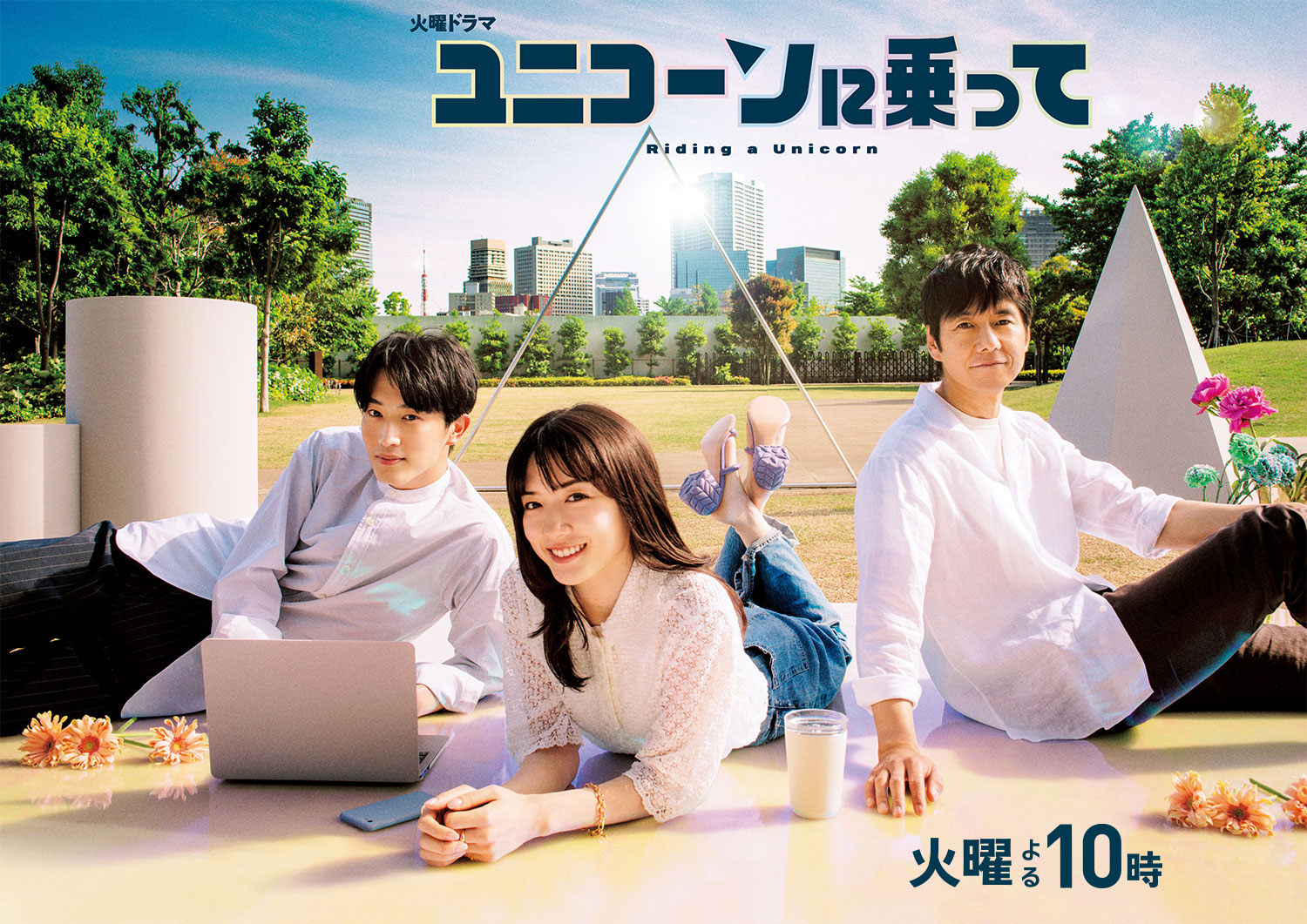
ユニコーンに乗って (Unicorn ni Notte/Riding a Unicorn) - TBS/2022
  • Sana (Nagano Mei from '3-nen A-gumi') was raised by a single mom and couldn't afford college. But after going to a local university to sit in on a seminar by her idol, tech entrepreneur Haneda Sachi (Hirosue Ryouko from 'Naomi to Kanako'), Sana was inspired to become an entrepreneur herself. By sneaking into classes at that same university, Sana met her co-founders: software engineers Kou (her future CTO who fell in love with her but kept it to himself due to their company's "no office dating" rule), and Jirou (her future head engineer).
  • Together, the trio founded Dream Pony, launching an app called Study Pony meant to make education accessible for all people, of all ages, for free. Study Pony was a massive hit when it launched, but now, after three years user numbers are lagging and Dream Pony's main investor is threatening to bail if things don't turn around. Sana comes up with the idea to revamp the app into a virtual campus called Study Pony Campus, and her team hires more staff to make this happen. One new hire is a socially awkward but genius software engineer, and the other is a middle-aged former banker with no tech experience but a passion for education (Kotori, played by Nishijima Hidetoshi from 'Blanket Cats'). While Sana pretends not to be aware of her and Kou's mutual feelings for each other, she also develops a crush on Kotori.
  • Sana's overall goal has been to make Dream Pony a "unicorn" company (a designation for the few start-ups that reach $1 billion in value, also the inspiration for Dream Pony's name and logo). But before that can happen, she must launch Study Pony Campus, get user numbers back up, and secure more investors so the company can stay afloat. Sachi's not convinced that Dream Pony is viable, but later becomes an investor and Sana's business mentor.
Meh: I could never get a solid read on how 'Unicorn ni Notte' wanted me to receive Sachi. At first I thought a Miranda Priestly-esque "never meet your heroes" dynamic was being set up between her and Sana, due to her reasons for rejecting Dream Pony from her "unicorn" incubator program: edtech is unprofitable especially given Japan's declining birthrate, all Sana has is her sob story to market Dream Pony and no actual innovation to back it up, and the dearth of female entrepreneurs in Japan isn't enough reason to give Sana's company a chance. Ouch, right? But then when Dream Pony wins a business competition, Sachi invests in them and even uses her own company's legal team to handle a patent dispute between Dream Pony and another start-up. So she's helping Dream Pony succeed, right? And she's become friends-but-maybe-more with Kotori, the resident nice guy, too. But then, she offers to buy Dream Pony from Sana, since now she apparently sees edtech as lucrative for fostering a new generation of entrepreneurs; Dream Pony would mostly remain as it is, but as a subsidiary of Sachi's company. The show frames this as an opportunity for Dream Pony to go global since Sachi's company is bigger and has more resources, and a chance for Sana and Kou to finally be together since they'll no longer be co-workers. (Kou switches to his father's company once the merger is complete.) And yet. Perhaps I'm simply not business-minded enough to get Sachi's motivations, but I couldn't shake how underhanded her buyout offer felt. Sana barely had time to bask in her own achievement before selling it to someone else.

Speaking of Sana and Kou, I recognize that this show isn't strictly a rom-com and is more about the life cycle of Dream Pony, with each episode exploring a different hurdle or phase that this particular start-up would have to handle in order for its app to succeed. I also understand that in 2022, letting an ambitious female character's career be overshadowed by her love life is played out. However, since the show went through the trouble of tracking Kou and Sana's history while also highlighting her growing attraction to Kotori, I'd hoped the romance would hit harder than it did. Why have a love triangle if it's not going to be juicy? Sana does choose between Kou and Kotori by the end, but the overall romantic element of 'Unicorn ni Notte' is more subdued than I would've liked. In fact, as a whole the show ends in this breezy, open-ended way that wasn't what I was looking for. Nothing is quite as conclusive as I was expecting.
 
Better: My only concern with the Study Pony Campus idea was having people of all ages using the app and learning together. I kept wondering, But... don't the Dream Pony peeps know that the internet is full of pervs? Should adults and children really be enabled to interact without some safety policy in place? So I was relieved to see Sana's team address this issue in episode 7, by devising new features to assuage parental fears about their children being harassed online, and also closing the digital divide in a rural area by having middle schoolers test out the beta version of the app on their school-issued tablets.
 
And in addition to seeing what Nagano Mei can do when not playing a high schooler anymore, I was delighted to see another familiar face: Thelma Aoyama! I've been aware of her for over a decade as one of the more notable Black and Japanese biracial women really doing it big and still having longevity in the Japanese music industry, and I was pleased to see her step into acting as the "Internet Woman" (インターネットの女/Internet no Onna) in 'FM999' last year. So I felt proud seeing her in another, bigger role this time as Megumi, one of Dream Pony's engineers and the only other woman on Sana's core team.

Best: Visually the show is bright and colorful, the design of Dream Pony's HQ looks playful and stimulating, and I appreciate that the show tries to inject some diversity into the office too. For instance, I'd already known that Thelma Aoyama is part Black, but 'Unicorn ni Notte' takes the extra step of showing her character video-calling her parents—with a Black man playing her dad—to remove any confusion about Megumi's racial background. And Kaito, the genius new hire I mentioned earlier, is revealed to be half-Korean; he became such a social recluse due to getting bullied at school for being Korean, and due to being perceived as generally "weird" by his peers and teachers. Of course, these are crumbs as far as depicting diversity goes, but they're crumbs that the show delivers well without being self-congratulatory. 

プリズム (Purizumu/Prism) - NHK/2022
  • Satsuki moved to Tokyo to be a voice actress, and while her roommate's career is off to a solid start, Satsuki realizes it's time to dream a new dream. Both young women work part-time at a plant shop, where Satsuki makes terrariums during slow periods. Satsuki gets let go from the shop, but not before meeting Riku, who's been eyeing her terrariums and whom she runs into while dispatched to a different work location.
  • Satsuki and Riku start dating, he gets her a job at his garden design firm, and he even helps her reconcile with her dad and her dad's male partner Shinji (not necessarily in that order). At first, Satsuki has a strained relationship with both her parents, who divorced when she was in middle school. Her dad had an affair with Shinji, whom he left the family for, and she still feels awkward around both men until Riku brings them all together. Meanwhile, Satsuki's mom nags her about moving back home and settling down, and remains hurt and bitter about the affair... but not forever.
  • What Satsuki doesn't know is that Riku also used to be in a relationship with a man, his former garden design professor (Yuuma) who disappeared seven years ago until now, when Riku's boss hires Yuuma to assist with an important and ongoing project. As Satsuki and Riku's relationship intensifies, Riku seeks answers from Yuuma about why their relationship ended so abruptly and where they stand now, and Satsuki becomes genuine friends with Yuuma before learning that he might also be her rival for Riku's heart.
Meh: Like I said earlier, 'Prism' is slooow. Let's not dwell on it.
 
Better: Ain't no shame in admitting it, I chose 'Prism' because I wanted to see how it would handle queerness. Granted, although Satsuki's dad, Shinji, Riku, and Yuuma are all obviously queer, the show doesn't explicitly attach labels like "queer" or "gay" or "bisexual" to them, and "same sex" only comes up a few times. But I think this lends well to the show's title and how queerness can vary depending on individual queer people's perspectives. (Consider the Merriam-Webster definition of a prism as, "a medium that distorts, slants, or colors whatever is viewed through it.") Which reminds me of the "Woman Who Fell in Love with a Woman" (女に恋した女/Onna ni Koishita Onna) song from 'FM999', where the actress describes sexuality as an ambiguous "gradation" that's never just one thing all the time. 'Prism' is messy in a "feelings and relationships are complicated" sort of way, but not in the cheap "Satsuki and Yuuma fight over Riku while Riku is indecisive about who to choose" way that I selfishly hoped it might be at first. (Although the latter part of that description is true; Riku genuinely wants to be with Satsuki but also can't make his love for Yuuma go away.)
 
I was also impressed by Satsuki and the men closest to her all being designers. She designs terrariums, her dad's an architect, Shinji is a stage designer, Riku is an exec at a garden design firm, and Yuuma is a landscaping expert who taught Riku practically everything he knows.

Additionally, though I didn't choose 'Prism' specifically for Sugisaki Hana (who plays Satsuki), when I began watching I was thrilled to suddenly recognize her as the girl whose mom runs an onsen in Her Love Boils Bathwater. (A 2016 film that I was able to watch earlier this year via Japanese Film Festival Online.) As I mentioned about Nagano Mei, it's refreshing to witness another young actress transition into such a fascinating grown woman role, especially when the only frame of reference I had was of her playing a child.

The ending theme song ("Yabai ne Ai tee Yatsu wa" by Hara Yuuko) kind of gives me "singing from another planet through a can" vibes, but I dig it! And this is just an extra little tidbit that I found out while writing this review: Asano Taeko, the woman who wrote 'Prism', also wrote my beloved 'Koi Nante, Honki de Yatte Dou Suru no?'! How cool is that?
 
Best: What the show lacks in pacing, it makes up for in vulnerability and emotional maturity, especially from episode 5 onward! My goodness! So many conversations, with such carefully written dialogue, addressing such difficult and sensitive subjects, with the characters displaying self-awareness and empathy that I only wish more people possessed in real life. The two instances that stand out to me most are when Satsuki's mom meets Shinji for the first time while visiting her ex-husband in the hospital in episode 5, and the highly charged confrontation that Satsuki, Riku, and Yuuma have in episode 8 when Satsuki insists they all get their intentions out in the open. I don't want to spoil the details of those conversations since they're among the choicest moments of the entire series. But I will say that in both scenes, the woman expresses her pain and frustration without being homophobic, and the men express their sincere desire to cause no further harm without apologizing for loving who they love. Given the circumstances it feels like a fine line to tread, but 'Prism' pulls it off in spades.
 
Alright, so the quartet of summer dramas I watched this time around were pretty aight across the board; loads of intentionality, but nothing altogether earth-shattering. With that said, my favorite of the four is 'One Night Morning' (see part 1 of this review). It's creative, it's short, it's vivid, it's romantic, it's empathetic, it's full of food, and I still can't stop thinking about the purple episode (episode 7) because it's so satisfying. Now that I'm all caught up, I'm curious to see what the fall 2022 J-dramas have in store. Best believe I'll be back to tell y'all all about it!

Thursday, October 20, 2022

ドラマ (Dorama) Time! 29 - pt. 1

No matter that October is almost over! I've just finished watching all four of my J-drama selections from the summer 2022 broadcast season, and I'm here to review them in the order that I finished them! (Which, coincidentally, is the exact opposite from the order that I started them.) The Meh/Better/Best approach that I came up with last time worked really well for me, so I'm going to keep rocking with that. First up are two dramas that I'm categorizing as "short and sexy (?)". They both only have eight episodes, around 25 minutes each, and there's onscreen intercourse that is meant to be sexy, but I was more intrigued by the narratives at play than the backs being cracked (hence the question mark). Plus I'm not usually in the habit of using "sexy" as a descriptor, so there's that too.
 
復讐の未亡人 (Fukushuu no Miboujin/The Vengeful Widow) - TV Tokyo/2022
  • Mitsuki (Matsumoto Wakana from 'Kingyo Tsuma') is the titular widow, whose husband Yuugo was the ace software developer at his job. That is, until he went to work one day and jumped from the roof to his death due to overwork and a hostile office environment.
  • A year later, Mitsuki (going by "Mitsu") has infiltrated her late husband's workplace as an ace software developer just like him, using her friendliness and helpfulness as a facade to investigate Yuugo's demanding boss, the co-workers who offloaded their work onto Yuugo the most, and whoever was the last person to interact with Yuugo before he jumped. She methodically zeroes in on each target and ruins their lives, from poisoning tea to temporarily abducting a cat to playing someone's adulterous sex tape at their wedding reception.
  • Behind the scenes is her brother-in-law Youji, a private investigator who disguises himself at the office and other locations in order to complete whatever task or gather whatever intel Mitsuki needs. Meanwhile, one of Yuugo's former co-workers (now Mitsuki's co-worker) becomes fond of "Mitsu", and adds perspective to who Yuugo was at work.
Meh: What I'm about to say is petty, but this show has the same problem as 'Tokyo Girl' on Amazon Prime. (FYI, I watched that J-drama when it initially debuted on Amazon Prime years ago, but chose not to review it because I wanted it to be just for fun. I might re-watch and review it later though.) And that problem is the hair! In both shows, the main character has a bob in the present, and when she's shown in the past having long hair, it's clearly the same bob with poorly-disguised extensions attached. I'm no hairstylist, so it's not like I could do a better job myself, but come on! At least don't make it so obvious, please!
 
Also, the backstory is that Mitsuki grew up with her future husband and brother-in-law (twins) because they were... her first cousins? Meaning she married (and boinked) her own first cousin? I kept replaying those parts of the show to confirm whether the trio was referring to each other as family in the figurative sense—like how we Black Americans often call non-blood-related loved ones "my cousin"—but I'm fairly certain they were being literal. Which means there's incest in this show that goes completely unaddressed, and it's treated as completely normal that both Yuugo and Youji fell in love with Mitsuki at some point. Apparently she only ever had eyes for Yuugo, even though Youji's the one who acted as her knight in shining armor when she was being abused by her stepdad, and who shared a bond with her that Yuugo knew he wasn't in on. (They committed double-murder as kids and promised to never tell Yuugo about it, but he somehow found out anyway.)
 
Better: Something about the way grief informs Mitsuki's revenge still lingers with me. I was expecting that Mitsuki would want to take the entire company down, but I was wrong. Suing the company would likely be unsuccessful (and the less interesting route), and it actually means something to her to not destroy the entire company, because in her mind that would erase the legacy of her husband's hard work. So the best solution she can come up with is to dole out specific punishments to specific people, using their most precious or most used items against them. Her approach is cunning, but also doomed to leave her dissatisfied because it's not all-encompassing.

On a separate note, I found out after I finished 'Fukushuu no Miboujin' that it's written by the same manga artist (Kurosawa R) who wrote the manga that 'Kingyo Tsuma' is based on. Tonally and from a "women dealing with dark situations but still getting their rocks off" standpoint, this revelation makes perfect sense!
  
Best: Regardless of the results, Mitsuki's commitment to her plan is what sells the entire show. Imagine being so loyal to your loved one and so committed to vengeance that within a year, you: change your name, learn to code, get hired as a programmer on the same research and development team at the same company that worked your husband to suicide, and even have an affair with your dead husband's unrepentant boss so you can slowly poison his tea every time y'all boink? And you convince your private eye brother-in-law to show up as the tea vendor/delivery man/custodian/security guard/whatever invisible role you need him to fill on any particular day? That's a woman who commits, and I respect it! Wouldn't be me, but I respect it!

And all things considered... Mitsuki gets an ending that isn't completely miserable. She executes her plan, has many of her questions answered, gets to walk away from the company without her true identity or motives being exposed, and then as a form of closure she ends the series by sleeping with the one co-worker she'd grown close to during this entire process. She herself is not "happy" per se, but she's done what she set out to do, and she's not all alone at the end.
 
ワンナイト・モーニング (Wan Naito Moningu/One Night Morning) - WOWOW/2022
  • Based on a manga by Okuyama Kenichi, each episode of this anthology series features a pair of young people—mostly 20-somethings, a few teenagers—spending a night together and then deciding how to address their encounter the next day. Despite the show's concept, sex isn't involved in every episode. Sometimes it's simply a pair of characters spending the night together because one of them is too drunk to go home, or one of them has no other place to go for the night, or they're working the night shift together. There's some sort of romantic tension in every episode, but that tension doesn't always lead to sex.
  • Each episode has a central color that informs all the visual elements. Episode 1 is lime green. Episode 2 is yellow. Episode 3 is light pink. Episode 4 is orange. Episode 5 is emerald green. Episode 6 is blue. Episode 7 is purple. Episode 8 is hot pink. Every episode, someone from the featured couple visits the same convenience store, where the lighting and the silent, bored-looking convenience store clerk's uniform always match the central color of that episode. 
  • Each episode also has a central food that the featured couple shares. These foods also tie into the morals of these stories, which I would paraphrase as, "You're more than fine as you are; even if you feel unremarkable, you don't have to become somebody else just to be valuable or useful or lovable. Sometimes you just need someone to see you, and eventually the right people will." Episode 1 is umeboshi onigiri. Episode 2 is shokupan/honey toast. Episode 3 is soumen. Episode 4 is gyuudon. Episode 5 is egg salad sandwiches. Episode 6 is cup ramen. Episode 7 is tsukimi soba. Episode 8 is nikuman.
Meh: The show's title refers to the morning after a one night stand, often referred to by English speakers as "the morning after". Obviously this show was made for Japanese audiences, but if the show creators were going to use an English title anyway, then I'm not sure why they didn't simply call the show 'The Morning After'. Maybe 'One Night Morning' sounds slightly more unique and mysterious? I don't dislike the title as it is, but the phrasing remains curious to me.
 
Better: I was so surprised to see Shigematsu, the silent convenience store clerk, get his own episode and actually talk! Episode 8 (the final episode) is mostly about him and his co-worker bonding over how isolated they feel due to being respectively hyper-visible (her and her large breasts), and invisible (him and his social anxiety). I was even more pleasantly surprised to witness how that finale paints 'One Night Morning' to be an understated thank-you letter to service workers, because after hearing how lonely it makes Shigematsu feel to be ignored by customers, we see a montage showing how the couples from the previous episodes wouldn't have experienced the intimate moments and revelations they had together without Shigematsu selling them the items they needed. He's had a significant impact on at least 14 people, without even realizing it. The last line of the series is literally a new customer telling him "Thank you" after he directs her to the walnut bread that she's come to the store looking for.
 
Best: Absolutely exceptional attention to detail and commitment to color schemes! From lighting to sets to costume design, everything is consistent with the chosen color of each episode. If you're someone who enjoys more of the stylistic aspects of film and TV, then 'One Night Morning' is for you.
 
And there are so many additional moments that I adore from this show! I adore how the male love interest in episode 3 is so smitten with the episode's lead character (his co-worker), that he proposes to her with the assurance that he'll take her last name if she doesn't like the way her new name would sound if she took his. Personally I wouldn't be thrilled to be ambushed with a proposal like that, especially not when I'm eating, and especially since the man and his co-worker have never so much as gone on a date. However! A man who's willing to take my last name? How very special and rare and feminist of you, sir! 
 
I adore all the different shades of blue shown in episode 6 because blue is my favorite color, and I adore that the episode uses Nicholas Britell's "Agape" (or a very convincing sound-alike?) as background music for some of its more emotionally-affecting moments. 
 
I adore how much the bespectacled and seemingly straight-laced lead of episode 7 (a widow who's also another co-worker of the woman from episode 3) is committed to being a discrete horndog. Emphasis on discrete. She has a secret "sex friend" (friend with benefits) of six months that she goes to love hotels with, after which they always eat tsukimi soba together before going their separate ways. Strictly sexual, plus soba. And I adore how vulnerable yet determined her sex friend is when he practically pleads, "I love you, woman! I know you're scared and grieving, but please let me love you!" at the end of that episode, when she tries to deny their mutual feelings for each other. (Also, I know I intimated I was "meh" on the sexiness of both 'Fukushuu no Miboujin' and 'One Night Morning'. But the love hotel scenes in episode 7, coupled with all the purple decor and purple lighting everywhere, truly delivered.)
 
That's all for part 1. Don't miss part 2!

Thursday, October 13, 2022

BOOKS! (The Obelisk Gate)

Listen. When I said in my last review that I'm locked in to this trilogy now? I meant it! I am LOCKED IN! It took me nine months to realize what a feat of brilliance I had on my hands with The Fifth Season (book 1 of N.K. Jemisin's Broken Earth trilogy) enough to finish it, and only three weeks to finish its sequel, The Obelisk Gate, which I'm writing about today. 
 
Before I dig into my spoilerific reviewlike I said last time, I'm explaining this series to y'all as I'm explaining it to myself, and this review will be as long as it wants to beI must give another shoutout to my marvelous friend Sho, who bought me the Broken Earth box set in the first place. After I messaged them about finishing The Fifth Season, they sent me some fascinating articles about Jemisin's writing process (including why she chose second-person narration, how she approached creating races in this universe, why she chose to "trick" readers into accepting Essun by presenting her as three different people, and the complex family dynamics depicted in Essen's younger lives). I am SHOCKED that Jemisin thought readers would hate Essun for being unlikable. Unlikable why? Because she's 40-something, a woman of color, a mom, has killed many, and is hard with people? Psshh! I've loved Essun in all her iterations so far, I refuse to be deterred by her supposedly-sordid details, and I refuse to judge any of her choices, especially when I can see through her hardness to grasp how loving and sensitive she truly is. That's my traumatized, cynical, messed up on the inside, don't trust nobody, prone to shame spirals, Black woman kindred spirit right there. And I'mma stick beside her!
 
The Obelisk Gate by N.K. Jemisin
 
Now. Book 2. On the TV review podcast This Too Much (by The Black Guy Who Tips), I frequently hear the hosts discuss episodes advancing the plot versus advancing the characters, and as a novel The Obelisk Gate definitely feels like the latter. Book 2 might not seem as action-packed as book 1, but the "Hold up, WHAT IN THE ACTUAL F**K is happening right now?!" factor is still prevalent, and book 2 does flesh out more of the rules (so to speak) of this universe that were established or hinted at in book 1. Rules such as:

Orogeny comes from the "sessapinae," a special part of the brain stem that only orogenes have. Guardians (having orogeny as a recessive trait but not fully being orogenes themselves) have their sessapinae permanently altered as children when the empire surgically puts an implant ("corestone") inside them to make them Guardians. These implants cause Guardians pain at the base of their skull for the rest of their lives, which is why they're always smiling creepily like they do, because they're told that smiling releases pain-reducing endorphins. These implants are also prone to "contamination" due to—I'm calling it now, but I might be wrong—the iron in them, making certain Guardians deranged. That's what happened to the female Guardian in book 1 who spoke to Essun (Damaya) as if possessed before Schaffa killed her. The implant also prevents Guardians from aging past a certain point; they can live for centuries.  
 
When enacting orogeny, orogenes emit a "torus" of ice that forms around them and freezes anything or anyone within a certain radius (a radius that orogenes can learn to control the size of). Think energy in, energy out, and bystanders die if they get too close. Sometimes orogenes "ice" people on purpose, or as a reflex to feeling threatened. Some orogenes can also turn people and things into stone, just like stone eaters can (or at least Hoa showed that he could in book 1). It took me until embarrassingly late in this novel to fully grasp that when Jemisin uses the word "stone," it doesn't just mean gray rock, which is what I'd been visualizing. In the Broken Earth universe, "stone" refers to all kinds of stones, including gemstones. So when living creatures are described as being "turned to stone," basically becoming statues and dying instantly, the deathly result is often quite colorful rather than dull and uniform. The reason some orogenes can turn living things into stone is because...
 
...Orogenes actually have two powers at their disposal. One is energy distribution (orogeny); it's the style that Fulcrum orogenes are taught, and that most untrained orogenes instinctively know to a certain extent, which focuses on sensing/"sessing" with their sessapinae and connecting down through the earth for power. (This style relies on heat/pressure/physical movement.) The other style, unveiled in book 2, is "magic" distribution (or simply, magic); it's a highly-advanced and lesser-known style that Alabaster teaches Essun and that Essun's daughter Nassun discovers on her own, which focuses on perceiving with their awareness and connecting up to the floating obelisks for power. (This style relies on the threads of silvery-looking matter or "magic" found inside all living organisms and inside the obelisks too.) With this style, orogenes can access the interior of any substance, which allows them to do nearly anything from transmitting their consciousness through the air and surveying the entire continent at once, to altering the atomic bonds in people's bodies and turning them into stone. Orogeny is activated by exerting force, while magic is activated by resonating with the obelisks, of which there are 216 (217?) floating around the continent.
 
Relatedly, orogenes whose powers are activated can have their powers combined, creating a "network" to achieve a desired purpose. The same can be done with obelisks too, and a network of connected and activated obelisks is called the Obelisk Gate. The orogene acting as a yoke between all of the obelisks ("opening" the Obelisk Gate) becomes omnipotent for the brief amount of time that they can handle channeling all of that power through themselves without being destroyed.
 
And apparently, stone eaters are people too. I stand corrected. They used to be regular humans before being transformed. In fact, Hoa (Essun's stone eater) and Antimony (Alabaster's stone eater) are among the first and oldest stone eaters. Certain stone eaters attach themselves to certain orogenes, becoming their protectors or companions for life. And this companionship is triggered by obelisks (in the sky) pulsing and then floating like magnets toward orogenes who've connected to them while using their powers, whether those orogenes mean to connect or not. The obelisks' pulsing and movement alert stone eaters (in the ground) to those orogenes' location as well, prompting interested stone eaters to race and fight each other to be the first to approach them and establish an alliance.

Book 2 also introduces some new villains while reintroducing some important old ones, including:

Earth, apparently the biggest villain of all. If stonelore is the closest thing to a sacred text in the Broken Earth universe, then the closest thing to God is Earth itself ("Father Earth"), which most people regard as malevolent ("Evil Earth" as opposed to, say, "Good God"). According to stonelore, Seasons did not exist and Father Earth was not malevolent until people, supposedly orogenes, over-exploited his resources by digging toward Earth's core to make and use obelisks for their power-hungry whims. (That's what the giant pits like the one Essun/Damaya found in book 1 were built for.) This exploitation somehow caused the Moon (capital M) to be flung away from Earth, and a Gospel-esque part of stonelore claims that Father Earth wages war upon humanity because humanity made his only child go away. Except it's actually the opposite of the Gospel story; it's not "For God so loved the world that he gave his only begotten Son" (John 3:16). It's, and I paraphrase, "For Father Earth so hated humans for taking the Moon from him that he avenged the loss by opening a can of whoop-a** on humanity, in the form of Seasons, for thousands and thousands of years to follow."
 
So the underlying conflict of this series is between Earth and humanity, and the "three-sided war" that Hoa and Alabaster explain to Essun in books 1 and 2 refers to the opposing objectives/factions concerned with how to end that underlying conflict. (Read: how to handle humans, who've messed everything up.) One side wants to eliminate humans; another side wants to neutralize humans by turning them all into stone eaters (supposedly stone eaters first came to be because Father Earth tried to make some people more earth-like); and another side wants to establish a truce where Earth and humanity can peacefully coexist (Hoa is part of this faction). Since stone eaters have been around for thousands of years, they're the main ones engineering this war, using humans as pawns. So far, the two clearest villains on the anti-human side are a stone eater known as Gray Man (who wants to turn all people into stone eaters) and the element/mineral/metal, iron. Iron is present as the tiny shards that line the walls of the obelisk pits, and is also present in the Guardians' implants (as mentioned above). Iron is somehow sentient, able to communicate with and invade the bodies of people who make close contact with it, possessing them on Evil Earth's behalf.

And last but not least of the villains, there's still Schaffa, Essun's former Guardian. Who to my bewilderment, ire, and disgust, did not perish when Essun blew up the island of Meov to prevent him from capturing her and her son toward the end of book 1. More on that later.

All of this additional information sets the stage for multiple showdowns to come (including a battle that happens toward the end of this book), and clearly defines one of the end goals of the series: using the Obelisk Gate to bring the Moon back in alignment with Earth, thereby appeasing Father Earth, which would restore seismic order and make Seasons obsolete so humanity can do more than just barely survive. It seems that all sides of the three-sided war want to retrieve the Moon, but not all are interested in the restabilization of humanity. Just like in book 1, book 2's chapters are divided between three main characters⁠—who are actually three different people this time⁠—and Hoa the stone eater is still narrating it all as if he's telling the story to Essun. In the order that The Obelisk Gate's main characters are first presented:

Nassun. Eight-year-old Nassun uses a diamond to bribe a traveling stone lorist to take her away from Tirimo, because she hates how much of a drill sergeant her mom Essun is during their secret orogeny training sessions. On the day of the great Yumenes quake, Nassun comes home to find her dad Jija has beaten her little brother Uche to death because the lorist had returned the diamond to Jija (who was home alone with Uche), and Uche revealed himself to be orogene by sensing the diamond in Jija's pocket. Jija can't bear to kill Nassun, however, because she looks like him and is his favorite child. Instead, he abducts her and they spend a year traveling south to an Antarctic comm called Jekity, which contains a compound within it called Found Moon where orogenes can supposedly be "cured" of their orogeny. But Found Moon is actually a place where orogene children who've been rejected by their families can train each other under the supervision of Schaffa and two other Guardians. So history repeats itself, with Nassun being influenced by the same Guardian who groomed her mother as a child. (Except Nassun is not afraid of Schaffa like Essun was, and is loyal to Schaffa in an overzealous way.) 
 
Over time, Nassun discovers new abilities by accidentally turning one of the other Found Moon kids to stone, and experimenting with "the silver" (magic) inside various living beings. She also accompanies Schaffa and another Guardian on a visit to the Antarctic Fulcrum, where she witnesses them slaughter the senior orogenes and then has a crisis about the horrors of the Fulcrum, which causes her to turn all the remaining orogenes  there into stone. (I'm still confused as to why she reacted by killing her own kind, but moving on.) On the way back to Found Moon, a gray stone eater introduces himself to her, and she names him Steel. Almost 11 years old now and fed up with managing her dad's volatile emotions while pretending to not enjoy being an orogene, she visits Jija one last time, Jija slaps the mess out of her, and she ices his house (but not him) on the way out to show him who the real gangsta is warn him against harming her further. Later, Jija comes to Found Moon attempting to kill Nassun, and Nassun kills him instead by turning him into stone too (but not before he manages to stab her in the shoulder). Steel witnesses all this but doesn't intervene, and afterwards manipulates Nassun into wanting to learn how to open the Obelisk Gate for him.

Essun. Despite Essun refusing to view the underground city of Castrima as anything but a temporary stopping point on her journey to finding her daughter, she gets roped into joining the headwoman's advisory council and training the comm's younger orogenes. Essun estimates that this current Season that Alabaster has started will last 10,000 years; humanity will likely go extinct unless someone does something about it, and both Lerna and Alabaster urge her to be that someone. As Alabaster slowly dies in the infirmary, gradually turning to stone as a side effect of using the Obelisk Gate to destroy Yumenes, he teaches Essun about magic redistribution so she can eventually use the Gate to bring the Moon back. (Finishing the mission that Alabaster began by slowing and altering the direction of the Moon's orbit when he destroyed Yumenes.) As a meat shortage looms, an army from a rival comm composed of elite stills leftover from the before times (Rennanis) sends a stone eater (Gray Man, also known to Nassun as Steel) to offer a deal: the Castrimans can join Rennanis voluntarily, but no orogenes are allowed. Gray Man holds Hoa's severed arm while delivering this message, and Essun rushes to her apartment to find Hoa in pieces. She feeds him the last of the special stones he's been carrying around since book 1, which enables Hoa to reconstitute himself into a young man made of black marble. This is the original form he was in when, as Essun now realizes, she (Syenite) first met him inside the garnet obelisk that exploded over Allia in book 1. Meanwhile, Castrima's headwoman Ykka (also an orogene) plans to hold a comm-wide vote on Rennanis's offer, but this inadvertently sets off a night of chaos where multiple people die, including Alabaster. (Essun gets triggered by the sight of a still woman about to beat down an orogene child like Jija beat Uche, she turns that woman into stone, and Alabaster uses his powers to intercept hers before she can stone everybody else. This saps the last of Alabaster's strength, and when Essun immediately goes to him in the infirmary, he's already dead and fully a statue, having left her a message: the enormous ovular onyx obelisk that he had Essun summon to Castrima is "the key".) 
 
Essun then shatters the ballot box and declares that orogenes' humanity is not up for a vote; she's decided to make Alabaster's death count for something by ensuring that Castrima remains united. She goes above ground to reject the Rennanis army's offer, and gets stabbed in the right arm by a Guardian she didn't know they had, but is spared from death when Hoa transports her through the ground. Essun and Ykka collaborate to combine all the Castriman orogenes' powers and prevent Rennanis from fully breaching the underground, but their network is disrupted when Rennanis-allied stone eaters start attacking them. Then Essun returns above ground (accompanied by Hoa), and uses the onyx obelisk to summon numerous other obelisks and open the Obelisk Gate. She wields the Gate's power to destroy the Rennanis-allied stone eaters, reach long-distance and turn everyone back in Rennanis into stone, and finally track Nassun down. She closes the Gate and passes out, but not before catching a glimpse of Alabaster (whom Antimony has remade into a stone eater). Hoa pulls her below ground again and takes her to Lerna's apartment, where Lerna discovers that Essun's right arm is completely stone as a result of opening the Gate. Hoa informs Lerna that the Castrimans can now move into Rennanis en masse—since Essun inadvertently damaged Castrima while trying to defend it—but that Essun will want to retrieve her daughter first. Hoa and Lerna clock each other's affection for and devotion to Essun, but seem to come to an understanding. For now.
 
Schaffa. Schaffa is about to drown in the ocean after Essun blows Meov up, but then he starts to panic. And in his panic, the cold and angry presence of the sentient iron within his Guardian implant speaks to him, seducing him into letting it overtake him so he can keep living. This presence gradually erases many of his memories and makes him feed off of people's magic like some sort of vampire, except he touches two fingers to the napes of his victims' necks rather than biting them. (He can consume magic from both orogenes and stills, but feeding off of stills kills them.) He learns these new things about himself after he washes up at a comm called Metter and an old, orogene-hating man lets Schaffa recuperate at his home. Schaffa accidentally feeds on Eitz (the old man's preteen grandson who's secretly orogene) when the boy approaches Schaffa for help, and realizing what he's doing and how satisfying it feels, he murders all the adults in Eitz's family before leaving Metter with Eitz. He and Eitz eventually arrive at Jekity, where Schaffa convinces the headwoman to let him create a Guardian compound which he names Found Moon. By the time Nassun arrives there years later, she becomes the tenth child in Schaffa's care. (Eitz was the first and is the oldest, and unfortunately he's also the kid that Nassun later stones on accident.) 
 
Schaffa quickly singles Nassun out as his favorite once she arrives at Found Moon, and he fixates on her even more after he realizes that she's Essun's daughter. He's the one who insists that Nassun move into Found Moon permanently when her issues with her father start hindering her training; he even body slams Jija to scare him out of interfering. Having mostly lost who he used to be, Schaffa claims to want to redeem some of his past misdeeds that he still remembers, which is his main motivation for operating Found Moon (a safe environment where orogene children can explore their powers more freely than they would've been allowed to in the Fulcrum). But this is directly at odds with his impulses, as the iron presence in his head tempts him to keep feeding on and killing people (including Nassun), and punishes him with shocks of pain when he doesn't yield to those urges. When Nassun realizes that she can use her "silver" work to remove Schaffa's implant so he won't hurt anymore, Schaffa refuses because he doesn't want to rapidly age and die as a result. Later, he's the only one besides Steel to witness the aftermath of Nassun stoning her father.

I wrote much in my review of The Fifth Season about the parallels between being orogene and being Black in America. And those parallels still stand in The Obelisk Gate, because the empire's official declaration that orogenes are not people, as quoted at the end of chapter 14, echoes the logic of American slavery. (The Stillness depends on orogenes' slave labor, and so orogenes must be categorized as not human to justify the bondage that sustains the Stillness's way of life.) But now, The Obelisk Gate has me recognizing being orogene as an allegory for queerness too. For instance, when Eitz approaches Schaffa, his biggest fear is being outed to his family (especially his grandfather) because he doesn't want to disappoint them or be harmed by them in retaliation. But then, when Eitz isn't around, his mother confides to Schaffa that she already knows that Eitz is different. In this way, Eitz's subplot seems to echo that of a closeted gay youth. As for Nassun, at the part when Jija brings her to Jekity so she can be "cured" of her orogeny, my mind immediately pinged and went, Oh! Conversion therapy. And when Ykka tells Essun the story of how her fellow Castrimans surprisingly embraced her when she revealed herself to be orogene as a teenager, she says that she "outed myself." There's also something to be said about learning differences in this novel, and people having varying (but no lesser) strengths. Nassun doesn't understand Fulcrum-style orogeny that well, but she thrives at figuring out how to connect to obelisks and work magic without anyone teaching her how. Ykka is self-trained, so there's a lot that Essun (Fulcrum-trained) can do that Ykka can't, but the reverse is true as well. Ykka can draw orogenes to Castrima (that's how Essun got there, because she felt pulled there) and already has experience combining other orogenes' powers with her own. In fact, she's the one who teaches Essun how to network with other orogenes, which makes Essun realize that Ykka doesn't need to know all the fancy little tricks because she knows how to do what's relevant to the needs of her comm.

If the biggest lesson I learned from The Fifth Season boiled down to, "The world doesn't have to be this way, and we don't have to live like this," then the biggest lesson I've learned from The Obelisk Gate is as follows. Even if there's no reasoning with bigotry/hatred/racism/foolishness/whateveryouwannacallit (some folks are lost causes), it's still worth it to believe in people and try living in harmony with them for the chance that they won't actually turn on you. A risk like that could be worth the potential cost. Because it's not about giving people an opportunity to prove their supposed inherent goodness; it's about you seizing your opportunity to live the life you want and deserve. For Ykka, that's a life of believing that orogenes and stills can truly live together peacefully, and that the Castrimans have her back because she's always had theirs. For Alabaster, that's the normal life that he, Essun, Innon, and Corundum had in Meov, even if only for a few years. And for Essun—who instinctively wants to "grab your runny-sack, grab your people, and run" but decides to stay and fight for Castrima and its ungrateful stills instead—that's whatever life will look like once this Season is, and hopefully all Seasons are, over. It's the better world that her children, especially her dead sons, have never gotten to experience.
 
Speaking of Essun's children, allow me to circle back to precious, impressionable, disillusioned Nassun. Initially, I sympathized with her but didn't see myself in her because I'm not a child, I don't have superpowers or siblings, my parents aren't murderers, and I've never been stuck on a creepy older man. But she and Jija have an argument in chapter 17 that unravels just like conversations with my dad used to, and that's when it hit me: Nassun adjusts herself around her dad's prickly emotions just like I had to do with mine, and over the same ages too (8 to 11)! I spent time alone with my dad because of post-divorce court-ordered visitation and not because of widespread (un)natural disaster like Nassun; I was shoved down once but not shoved out of moving transportation and sent rolling down a jagged hill like Nassun was; and I wouldn't call what I did "manipulating," which is what Nassun believes she does to placate her father. However. Whittling myself down into some approximation of the girl my dad thought I was, and funneling my actions, thoughts, and emotions into a limited range of acceptable expressions to avoid making him angry or primed to argue over something ridiculous? I definitely did all of that. Even the religious undertone of Jija's complaints and demands feels familiar to me. Like how he's bent on curing Nassun of her orogeny (my dad briefly tried to pray away my need for certain medications); or how he calls Found Moon a "den of iniquity" and forbids Nassun from fraternizing with certain children, even though he's never spent significant time there or gotten to know Nassun's peers (check); or how "How dare you disrespect your father!" flares up in him when Nassun gently counters him with truth he doesn't want to hear, because he perceives that as a challenge (no joke, I heard "The Bible says honor your father!" as a rebuttal until I was at least 22). Obviously Jija is an extreme case, and I didn't live Nassun's childhood to the exact same intensity or extent, but her experience is still very reminiscent of my own.

Today my dad and I text each other sporadically, which is as much communication as I'm comfortable with. I no longer feel the need to lament how he treated me as a child, and thinking about it doesn't affect me like it used to. But it did lay the foundation for me bracing myself for people's worst or not expecting much from them at all, avoiding them, being reluctant to trust them, and also being reluctant to wholeheartedly believe in the necessity of community to my personal well-being. So to read about a young Black girl being stuck with her estranged father under very specifically-distressing circumstances and eventually realizing she must sever ties with him (Nassun), in tandem with reading about a Black woman re-learning despite herself how to trust in people's better nature and rely on community to survive instead of cutting and running out of self-preservation (Essun)? That whooped my behind, I'm not gonna lie. I felt like N.K. Jemisin was telling me about myself.
 
Honestly speaking, whereas The Fifth Season left me feeling hopeful and energized, The Obelisk Gate has me feeling... sad. I enjoyed book 2 a lot, but it did have me catching a few stray hits. (I don't resent or take offense to this, I just wasn't expecting these characters' drama to come knocking at my front door. Now why am I in it, N.K. Jemisin? Why are you doing this to me?) And even though I've arrived exceedingly late to the party, I'm all in now and the Broken Earth trilogy has given me something to be enthused about, something to look forward to (and at the risk of sounding too dramatic, something to live for). So it's sad to know that this party is already two-thirds over, and I don't know what will take its place. Today is Thursday, my third day in a row of wrestling emotionally with finishing this book review—which I guess turned into more of an essay, so thank you for reading this far—and this morning I even spent most of my weekly therapy session talking and crying about everything I've just relayed to you all. I'm simply not ready to let this series go. Now, does this mean I'm going to restrain myself, savor book 3, ginger it slowly, and take my time with it so I can make this adventure last as long as possible? Of course not! Off to gobble up book 3 I go! 

Favorite quotes:
"I'd been looking at diagrams of the obelisks, trying to understand what their builders intended. My head hurt. I knew you were alive, and I missed you so much I was sick with it. I had this sudden, wild, half-rusted thought: Maybe, through the hole, I could get back to you" (168).

"It takes all of herself, and the confidence that comes of delight, to engage with the earth to her fullest" (188).

"You'd almost forgotten this part of him: the dreamer, the rebel, always reconsidering the way things have always been because maybe they should never have been that way in the first place. He's right, too... There's a reason Alabaster was the magnetic core of your little family, back when you were together. 
 
Damn, you're nostalgic today. It prompts you to say, 'I think you're not just a ten-ringer... You're always thinking. You're a genius, too—it's just that your genius is in a subject area that no one respects'" (204).

"No vote... Leave. Go join Rennanis if they'll have you. But if you stay, no part of this comm gets to decide that any other part of this comm is expendable. No voting on who gets to be people" (334-35).
 
"I wish you could love me anyway, even though I'm bad... I tried to keep loving you, but it was too hard" (387).

Saturday, September 17, 2022

BOOKS! (The Fifth Season)

Sometimes your friends suggest stuff to you and they're actually right. You think you won't be down for it, but they're right. Like, seriously right. I didn't get it back in December 2021 when I started this novel, and honestly still didn't fully get it when I passed the halfway point at the end of August this year, but I get it now. Last December my dear friend Sho was visiting from Tokyo, and we met up at a Korean cafe for some boba (for them) and bingsu (for me). They surprised me with a box set of N.K. Jemisin's Broken Earth trilogy as a Christmas gift, with the disclaimer that they knew sci-fi and fantasy aren't usually my thing, but they genuinely thought I might enjoy this book series as much as they did, and hoped I would give it a try. So, to humor my friend and show gratitude for their thoughtfulness, I started reading book 1 (The Fifth Season) that same month, and then progressed through it leisurely all 2022. But something happened in chapter 13 that had me picking up speed this month. And then from chapter 17 onward I literally could not stop. I needed to know what would happen next, and next, and next.
 
I stayed up all night Thursday finishing The Fifth Seasonaltogether it's 449 pages divided into 23 chapters, plus a few interludes—then I rested and let the book marinate in my mind on Friday, and here I am Saturday writing this review. And I do get it now! Sho was so right! I'm writing about this novel on its own because it's taken me nine months to finish it, and its meatiness requires my undivided attention. This review will be as long as it wants to be. This review will also be overflowing with spoilers, because I'm using it to piece things together so I can dive into book 2 with my head on straight. (Although I suspect there's no way to prepare for what N.K. Jemisin has in store in that one.) In fact, this might be the most spoilerific book review I've ever written; I'm explaining the book to y'all as I explain it to myself.

The Fifth Season by N.K. Jemisin
 
In this book's futuristic universe, the entire world consists of a single continent called the Stillness (think a re-formed Pangaea, except it's faintly shaped like Africa). People live in all different types of communities ("comms") depending on their geographic location, and their full names are composed of their given name (first), their "use name" based on their skill or occupation group (middle), and the comm they come from (last). Every few centuries or so, environmental disasters (especially but not exclusively earthquakes or "shakes") happen of such magnitude that they set off a period where conditions become inhospitable for most human, animal, and plant life, and comms are destroyed or reshuffled. These periods are called "The Fifth Season" or simply "a Season", capital S. (Think an extended winter like The Long Night in 'Game of Thrones,' except it happens multiple times and each Season is given its own name.) Humanity basically has to start over again once conditions become stable, with survivors establishing a new civilization to replace or pick up from where the previous civilizations (or "deadcivs") left off. Much reference is made to "stonelore," the preeminent sacred textor mere folklore, depending on if people believe it or not—and historical record of this world. In the current civilization within The Fifth Season, the Stillness is united as an empire, with the imperial capital and biggest city being Yumenes (population: seven million).
 
In this same universe, there is a minority of people born with the power to sense and manipulate the environment around them, which is most often expressed through their ability to start, stop, and divert earthquakes. These people are called "orogenes," their power is called "orogeny," and people who don't have this power (the majority of the population) are called "stills." Because their power can be unpredictable and isn't fully understood, orogenes are treated like monsters by most stills, and regarded as dangerous weapons by the empire. To make that danger useful, the empire has established the Fulcrum, an enormous, heavily-guarded military complex within Yumenesa city within a city, reallywhere orogenes live, work, and are trained from childhood to use their powers to serve the public. After completing school (or "creche"), they wear official black uniforms and acquire rings that signify their skill level as their careers progress (ten-ringers have the highest rank). Orogenes who aren't born and raised in the Fulcrum, aren't able to live in peace in other comms, and are still young enough to be trained, are often located and corralled to the Fulcrum by "Guardians," CIA agent/slave catcher hybrids who wear unsettling smiles and burgundy uniforms. (Guardians also live and work in the Fulcrum. They're children of orogenes but don't have any orogeny themselves, and are genetically predisposed and surgically modified to be able to counteract orogeny instead. In other words, their job is to ensure orogenes fear them, obey them, and never become too powerful. Any Guardian can exercise this authority over any orogene, but each orogene also has their own specific Guardian who's assigned to them for life.) Also in this universe, there are gigantic, man-made, upside-down, mostly hexagonal crystal obelisks of varying colors floating around the continent. No one remembers why they exist, but they become important later.
 
The Fifth Season opens with a prologue where an as-yet-unnamed orogene man and his companion—a mysterious stone creature called a "stone eater" who isn't human but can make herself appear like one, and who speaks without moving her mouth—look over Yumenes before said man, intending to break the world, creates an earthquake that destroys the capital and sets off a new Season. (This event becomes known as "the Yumenes Rifting" or simply "the Rifting.") The chapters after that follow any one of our three main characters, who are each orogene women/girls. In the order that they're introduced:

Essun. A 42-year-old wife, mother, and schoolteacher living in a comm called Tirimo, where she's been passing as a still for the past 10 years. The only people who know her secret are her friend/neighbor Lerna (a doctor), and her two young children who are orogenes just like her. The day of the Yumenes quake, before its reverberations would have hit Tirimo, Essun finds her almost-three-year-old son Uche dead at home, and her daughter Nassun (older than Uche) missing. (Presumably, at least as Essun has deduced, her husband Jija discovered that Uche was orogene and beat him to death, then fled with Nassun in tow.) While mourning over her son's body, she diverts the Yumenes quake away from Tirimo when she senses ("sesses") it coming, but this tips off everyone else in town that she's orogene, and she has to flee the comm because they're biggots (and because she needs to find her daughter). She then heads southward, in the opposite direction of Yumenes, and is gradually accompanied by a little boy named Hoa (a stone eater) and a trans woman named Tonkee, a scientist who's obsessed with studying obelisks. They eventually arrive at a comm called Castrima, which is an above-ground front for an underground geode city that runs on orogeny and actively summons orogenes. Essun doesn't find her husband or daughter there, but she is reunited with Lerna... and someone else too. Essun's are the only chapters written in second rather than third person.

Damaya. A little girl in a rural comm who's the only orogene in her family; her parents (especially her abusive mother) fear her and make her live outside in the family barn once her powers become too apparent. Her mother arranges to have Damaya taken away, and that's when a Guardian (Schaffa, Damaya's specifically-assigned Guardian) arrives to take Damaya to Yumenes. Damaya thrives as an advanced learner at the Fulcrum, and when she realizes she's being bullied by other kids (or "grits," as orogene children in basic training are called), her method of stopping them has extreme but conclusive consequences. Additionally, she wanders around the Fulcrum during her free time. Which is fine, until she and a still girl who's posing as a grit find a secret passage, which leads to a secret pit where the floating obelisks used to be made. On top of seeing what she's not supposed to see, the Guardian who catches them becomes possessed and starts telling Damaya vague but ominous things that she's not supposed to hear, and Schaffa kills that Guardian in front of Damaya. If Damaya can't be obedient she must at the very least prove herself useful, and so Schaffa immediately makes her pass her first ring test to spare her from being gravely punished for the discovery she's made.

Syenite. A four-ringer in her 20s trying to climb the Fulcrum ranks and earn a cushy, quiet life, who is assigned to breed with her new mentor, a ten-ringer named Alabaster. They're dispatched to a coastal city called Allia to clear coral from the harbor there, but this mission is merely a cover for them to go way together and make a super powerful orogene baby for the Fulcrum to raise and cultivate. Someone poisons Alabaster's food, and while he's recovering Syenite removes the coral on her own. Which is fine, until she also accidentally unearths a cracked garnet obelisk (with a seemingly-dead stone eater inside?) that was buried in the sea. After Alabaster recovers, a Guardian shows up and attacks them both, and Syenite accidentally sets Allia on fire trying to defend herself. (She harnesses energy from the obelisk and the obelisk explodes, leaving a volcano in its wake.) Alabaster's stone eater friend (Antimony) whisks him and Syenite to a pirate island called Meov where orogenes are celebrated and appointed as comm leaders. There, Syenite and Alabaster both fall in love with the comm leader called Innon, Syenite gives birth to Alabaster's son (Corundum), and they're a happy throuple family for almost three years. Until Syenite goes back to Allia to seal the volcano, which alerts the Fulcrum and has a fleet of ships descending upon Meov to seize Syenite, Alabaster, and their baby. Alabaster gets saved by Antimony again, Innon is murdered by a Guardian, and Syenite—cornered by Schaffa and refusing to return to the slavery of the Fulcrum—tries to kill herself and her son by using an amethyst obelisk to wreck Meov and its surroundings. (Think that infanticide scene in Toni Morrison's Beloved, or the real 1856 story of Margaret Garner that Beloved is based on.) Except Syenite lives, and after washing up back on the Stillness and wandering for two years, she settles in Tirimo and takes on a new name: Essun.

"THEY'RE ALL THE SAME F$&$&&# PERSON?!?!??!?!?!? N.K. Jemisin is a genius, I swear." That's verbatim what I messaged Sho when I read the reveal, and both statements are true. I was marking all of Syenite's chapters with post-it notes because hers were the most resonant to me, and they had the most levity/humor/sarcasm. Little did I know that every chapter is technically a Syenite chapter! The Damaya and Syenite connection came first (Damaya takes on the name Syenite when she earns her first ring), which I'd already sensed by a certain point in the book. But then I immediately thought, YO... What if Syenite started a new life and renamed herself Essun? And I was right! Not only that, but Alabaster is the unnamed man at the beginning who, after being rescued from Meov, intentionally tries to destroy the world in order to avenge himself and his family. That's him and Antimony in the prologue. He's also the other person Essun reunites with in the underground city of Castrima. Also, Tonkee is the still girl who discovers that pit with childhood Essun. Oh and also, Hoa's been narrating this whole thing.
 
And I thought the Henry/001/Vecna reveal at the end of 'Stranger Things' season 4 (volume 1) was impressive! Truly, I'm so amazed by how things work together because like I messaged Sho, "Timing really is everything when it comes to when you consume media and how you respond to it. I watched [the Vecna reveal] in May and was blown away. Because of that (and because of clues that I picked up in Jemisin's writing), I was open to a similar thing being possible in The Fifth Season, and so while it wasn't a COMPLETE surprise, I was still blown away by how she pulled that off. Made me appreciate the ingenuity even more, even if I could sense that the reveal was coming." And whereas I shouted while watching 'Stranger Things' because the brilliance of that villain origin story was so thrilling, the Damaya/Syenite/Essun reveal in The Fifth Season stunned me into complete silence. My stomach dropped and I had to look away from the book and just sit in stillness (no pun intended), with my hand over my face. Because... my God. This woman has gone through so much. Too much. She's lost three different families! She's had two different sons, twelve years apart, both die at the age of two! This woman is believable as three separate characters because Damaya, Syenite, and Essun's respective chapters genuinely read like separate lifetimes. But at the same time, you can pinpoint the exact moments where our hero transitions from a love-starved child unaware of the depth of her power, who's a brilliant student and also a little too curious for her own good (Damaya); to a sarcastic and confident young woman whose sense of justice eventually eclipses her ambition to play the game of the Fulcrum (Syenite); to a jaded, grieving mother who mentally beats herself up at the slightest distress because she thinks she brings death on all around her (Essun).
 
I didn't look up any information about The Fifth Season before I read itI simply trusted Sho's recommendationand the only writing of N.K. Jemisin's that I'd read previously was her "Dreaming Awake" essay in Well-Read Black Girl. But knowing that the author is a Black woman, I based my reading of The Fifth Season on my own presumption that all characters were Black unless described otherwise. And that approach actually helped me understand the story more thoroughly than I could've anticipated. Canonically, orogenes can be any race, but the parallels between being orogene and being Black in America are there. "Rogga" is the slur of choice that stills hurl at orogenes (and that some orogenes use amongst each other), and how is that not an obvious reference to "nigger" or "nigga" for Black people? And let's not forget the respectability politics of the Fulcrum! Orogenes use their abilities to save lives and entire comms, yet they must demonstrate an inordinate amount of self-restraint to avoid punishment for being a perceived danger to the public. They are reduced to their usefulness, severely over-surveilled, not allowed to leave their dwelling without official permission much less create a different life for themselves, not allowed to do anything that might scare the stills, and are all the while expected to be polite and grateful. That don't sound like being Black in America to you? The science-y part of this novel might not be my forte, but I was still picking up the messages that Jemisin was putting down! With that being said, although the book repeatedly describes being part of the Fulcrum as slavery, for the longest I couldn't internalize that because the Fulcrum wasn't giving plantation to me. It was giving specialized, extremely stringent branch of the military; it was giving bureaucratic mega-corporation; but it wasn't giving plantation. It wasn't until Essun and Alabaster left the Fulcrum and started interrogating what they went through that the slavery parallel set in for me. And their stand-off with those Guardian ships in chapter 22 made it even clearer. 
 
Looking at The Fifth Season as social commentary, even though the book is quite emotionally heavy, I felt refreshed by the frequently-expressed idea that the way we live now is not the only or best way to do things simply by virtue of it being a long-established status quo. It wasn't always like this, and it doesn't have to be like this in the future either. Furthermore, there are places where the undesirable are not only appreciated, but respected and valued as essential. In other words, our current world shaped by colonialism, white supremacy, and capitalism is not the only world we can aspire to. It's not the only possible pinnacle of human achievement. We can create spaces of our own; we can try to make this world a better one. Imagine reading a book about the world ending over and over again, and genuinely finding hope in it (and not in a cynical or depressed way either). Sounds ridiculous, right? But that's precisely what I found. And that's another reason why I believe Jemisin is a genius.
 
To start rounding things out, let me list a few more aspects that I adore about The Fifth Season. Lube and dildos exist in this universe! Queer people (especially queer men) exist in this universe! A trans girl (who lives long enough to be a trans woman) exists in this universe! Black matriarchs are still called "Muh Dear" in this universe! A polyamorous family exists in this universe! BDSM (is hinted at existing) in this universe! Birth control exists in this universe! And I mean, sure, a ton of people die as a result of Essun and Alabaster's respective world-breaking, including their own son. However. Imagine being a Black child whose parents love you so fiercely that they would destroy an island to spare you from bondage, and fell an imperial capital to take vengeance against the people who dared try to capture you. Is that not the very embodiment of, "I don't play about me and mine"? I can't not be moved by that!

And finally, I leave you all with the last (for now) of the flurry of messages I inundated Sho with immediately after finishing The Fifth Season: "Oh, and thank you for buying me the set and convincing me to give this trilogy a try. It's taken me nine months to read the first book because I was apprehensive about not understanding things (because sci-fi/fantasy) and was slowly getting used to the world of TFS, plus the tone of it is pretty dreary at times. But once stuff started popping off after Syen accidentally pulled that obelisk out of the sea and it shattered, the Blackness and the queerness started REALLY jumping out in earnest, and I realized that D/S/E might be (are in fact) the same person, I was like, 'OH! We're cooking with grease now! I'm locked in!' Haha." What else I gotta say? Read this book!
 
Favorite quotes:
"His fingers spread and twitch as he feels several reverberating points on the map of his awareness: his fellow slaves. He cannot free them, not in the practical sense. He's tried before and failed. He can, however, make their suffering serve a cause greater than one city's hubris, and one empire's fear" (6-7).
 
"There should be a better way. There must be. Sanze can't be the first empire that's managed to survive a few Seasons. We can see the evidence of other ways of life, other people who became mighty... I realize you only have the education the Fulcrum gave you, but think, will you? Survival doesn't mean rightness. I could kill you right now, but that wouldn't make me a better person for doing so" (123-24).

"There passes a time of happiness in your life, which I will not describe to you. It is unimportant... But what is important is that you know it was not all terrible. There was peace in long stretches, between each crisis. A chance to cool and solidify before the grind resumed" (361). 

"Allia, this was Allia, this was a human place, there were people here. People who didn't deserve to die because
of me
because they were too stupid to let sleeping obelisks lie, or because they dared to dream of a future. No one deserves to die for that" (383).

"This is home until I can escape it" (388-89).

Wednesday, August 31, 2022

BOOKS! (I Think I Might Love You + The Perfect Find)

Truth be told, August hasn't been the greatest month for me, and even as I try to write this review, I'm not in the greatest of spirits. Maybe this review will be shorter than usual, I don't know. But one of the things I tried to do this month to lift my spirits (or at least sufficiently distract myself) was read Black romance! Specifically, the two romance novels I ordered as a 4th anniversary/100th episode present to myself (see Young, Gifted and Abroad). First up is a novella about a late-blooming college student/ice cream franchise owner with anger issues, being mutually aggravated yet charmed by a veterinarian tasked with supervising her community service after she vandalizes her ex's car. And then, a novel about a 40-year-old fashion magazine editor whose second chance at her New York career includes a second chance at love... with a 22-year-old filmmaker/coworker who's also her boss's son. 
 
I Think I Might Love You by Christina C. Jones
 
I wasn't exaggerating when I said that Carole V. Bell's essay "I'm Rooting for Everybody Black: Black Solidarity, Black World-Building, and Black Love" (from Black Love Matters) thoroughly sold me on I Think I Might Love You! I'd never heard of the novella or Christina C. Jones when I read that essay, but Bell's description of how overwhelmed the male lead (Kadan, in his early 30s) is by the female lead's beauty as a Black woman (Jaclyn or Jac, in her mid-20s) was too alluring for me not to read the whole novella for myself. Because who doesn't want to imagine being worshiped like that, even if Kadan keeps his reverence for Jaclyn to himself at first? 
 
Kadan has good reason to hold back because 1) the first time he meets Jaclyn, she's drunkenly using her key to let herself into his apartment (the one he's subletting from Jaclyn's sister, which Jaclyn hadn't known about), then punching him in the face and kneeing him in the groin when he, caught off-guard and in the nude, confronts her about the intrusion. And 2) Jaclyn is exactly his type. He loves wild women, as did his father, but hoeing basically cut his dad's life short and Kadan doesn't want to risk the same fate. So when Jaclyn unexpectedly walks into his vet clinic not long after their dustup, carrying the stray cat she found on her fire escape and later asking to volunteer there since she's been sentenced to 400 hours of community service—his clinic is the only court-approved establishment that still has volunteer spots open—he keeps his obvious attraction to her under wraps.
 
But then there's all the slick, sarcastic banter that evolves into flirting so seamlessly that neither of them even have to try, because they're both feeling each other. And then there's the house call when Kadan comes over to check on the stray cat (Miss Thing) that Jaclyn reluctantly adopted, which leads to the human pair doing "qualitative research" in Jaclyn's bed. And then there's the time when Kadan helping to serve a rush of customers at Jaclyn's ice cream shop leads to him also helping her relieve some stress on top of her office desk. And then there's their fake-dating arrangement to get Kadan's sadiddy aunt (the judge who sentenced Jac to 400 hours of community service) off his back; Jaclyn pretends to be Kadan's girlfriend when judge auntie visits the clinic, and she's his date to their local university's alumni ball (where judge auntie tries to set him up with a sadiddy woman just like herself). Jaclyn and Kadan had agreed not to catch feelings the first time they had sex, but by the time they go to the alumni ball, feelings have been caught! So they agree to give Jaclyn some extra time alone to mourn her previous relationship and focus on graduating, before moving forward with their new relationship.
 
I must say, naming the cat Miss Thing is one of the most brilliant choices that Christina C. Jones makes with I Think I Might Love You. It's such a telling name. Jac doesn't want to keep the cat, much less name it, so she starts calling it Miss Thing in an unsuccessful attempt to remain detached from it. And that name, "Miss Thing" is so impersonal and full of contempt, but is also such specific Black-woman-putting-someone-on-notice phrasing (almost as pointed as addressing a woman or girl as "Little Girl", regardless of her age), that it's actually adorable! Especially given the fact that despite Jac's grousing and trying to act mean, everyone around her calls out the fact that Miss Thing ain't going nowhere! That's her cat now.

The only thing that rankles me about I Think I Might Love You is that Kadan doesn't go to Jac's graduation ceremony; he surprises her at her apartment after the festivities are over instead. Sure, he wants to give her space to focus on finishing school and process how she feels about him romantically, and the idea is for them to pick up where they left off after graduation. But how does that translate to him not showing up for the ceremony at all? Kadan's reasoning is that he didn't want to make Jac's day about him, but... huh? How would him being there make the day about him? This is a huge milestone in Jac's life, one I'm sure she would've wanted to celebrate during the day with both him and her folks (who already know about him), but he doesn't show up for it because his mere presence would somehow take precedence over everything else? That still doesn't make sense to me. Other than that, though, I'm so impressed with ITIMLY. It's a wonder that Jones has been able to fit such a robust love story into a mere 133 pages! I wish it were longer, but maybe that's where the other two books in the "Love Sisters" trilogy come in. We'll see. If you appreciate snark, relationships hilariously starting off on the wrong foot, foul-mouthed Black women who have good hearts but are often misunderstood, rescue cats, workplace romances, Black college towns, or admittedly hoe-ish veterinarians, then read this book!
 
Favorite quotes:
"I put a few pieces in the bowl—then stopped to check the internet to make sure cats could even eat chicken [...] I slid the bowl to her, close enough she wouldn't have to move too much to get to it. That heifer took one sniff, looked at me, then put her head down without even touching it.
 
I sucked my teeth. 'Okay, I know your ass isn't being picky?' I pushed the bowl closer, prompting her to lift her head for another long 'bitch, can't you tell I don't want this??' stare" (14).
 
"'I think I might... love you,' I admitted. 'Just a little though. Like, right at the beginning, you know? And I know it's stupid soon to say something like that, but it's just the truth. So if me being a weirdo and saying that isn't too much of a turnoff, then—'" (133).

The Perfect Find by Tia Williams

I knew that Tia Williams had another successful romance novel before Seven Days in June, and I'd heard that Netflix has a movie based on The Perfect Find in the works (due in 2023, with Gabrielle Union and Keith Powers playing the leads Jenna and Eric, and Black & Sexy TV founder Numa Perrier directing). But my introduction to Jenna and Eric was actually their cameo at a party in Seven Days in June! Which kind of spoiled the HEA of The Perfect Find for me, because I knew already that in the Tia Williams extended literary universe, Jenna and Eric do end up married, raising their rambunctious toddler named Otis together. All the more reason to read The Perfect Find, though, right? Because I knew going in that it wouldn't be a downer.

Well, The Perfect Find doesn't end as downer, but Jenna is in a pretty low place at the beginning. In 2012, 40-year-old Jenna has just returned to New York after spending a couple years hiding out in her rural Virginia hometown. Hiding out became necessary after she broke up with her fiancé Brian, a real estate developer whom she'd been with since her late teens (they were college sweethearts), and whose obsession with wealth and reluctance to get married or start a family left Jenna with little choice but to leave their high-society New York life behind. Which meant not only selling most of her fancy outfits, but also being replaced as fashion director at a print magazine during her absence, losing most of her and Brian's mutual high-society friends, and starting over from scratch financially. Having had enough time to wallow, lick her wounds, and keep sharp by teaching some fashion courses at the local community college, Jenna makes a deal with her rival Darcy, who arose as a fellow Black woman in media/fashion at the same time as Jenna (especially the late 1990s and early 2000s). The deal: Jenna can work as an editor at Darcy's street style digital magazine (StyleZine), at a significant pay cut, under an eight-month contract. In those eight months, Jenna must use her style advice column and the new web series that Darcy's assigned her to develop to triple StyleZine's readership, otherwise Jenna's fired. 
 
Buzzing with the stress of her new job and of still being single while her ex has already found someone new, Jenna goes to a party and drunkenly makes out with a handsome young stranger on a Friday night. Only to go to work Monday and have Darcy introduce that stranger as Eric, Darcy's son, a 22-year-old recent film school graduate who'll be Jenna's videographer for the new web series (along with helping her understand social media). After antagonizing each other at first, Jenna and Eric try to be adults about this wild coincidence, putting their previous encounter behind them in favor of being excellent collaborators and solid friends. Their desire for each other is palpable, however, hence an office romance that evolves from secret texting, to secret dates, to secret trysts in the fashion closet that only Jenna has the keys to. They're putting both of their jobs at risk (since they both rely on Darcy's good graces for their livelihood), and their life goals differ greatly. In addition to getting her career back on track, Jenna desperately wants to be a mom and her fertility options are waning, whereas Eric is living out his 20s and just beginning to establish himself as a venerable filmmaker. But can their devotion to each other and mutual movie nerdery compensate for the fact that they're at such different stages in their lives? The Perfect Find is the name of their web series, which becomes a massive hit, but of course the phrase also refers to Jenna and Eric unexpectedly finding the true love of their lives in each other.

Seven Days in June is still my favorite between the two novels (and still my favorite read of this year) due to how much I relate to it on a personal level, but from a steamy romance standpoint, The Perfect Find is way hotter. Like, waaaay hotter! And I was not prepared! There's a BDSM-lite power play thing that Jenna and Eric do leading up to and during the first time they have sex—steered mostly by Jenna, as it's important for her to reclaim her sexual power after letting Brian lead for two decades—and gah-lee! That made the prior 170 pages of will-they-won't-they after their drunken makeout session worth the wait! When she's not worrying about what their relationship means or what their future together looks like, Jenna is a tease with Eric, and the book itself is a bit of a tease too. TPF makes you wait, and then it delivers, over and over again.

I'm not a fashionable person, and occasionally I can fall into the trap of dismissing certain fashion and beauty-related phenomena as superficial or frivolous. So it was refreshing for me to learn about that world from Jenna's perspective (no doubt modeled off of Tia Williams herself, who was a beauty editor for 15 years and has the same Jennifer Beals à la Flashdance curls that Jenna's described as having). Sure, the fashion industry is both ridiculously fun and stupefyingly cut-throat, and the people working in it can be desperate and petty. However. This thing, fashion, is also art. These people are also artists. The advice Jenna gives in her style column and to fashion school students, in addition to her own silly yet meticulous habit of giving a name/theme to all of her outfits, demonstrates her immense knowledge of how much clothes reveal about who people are and what they want. As far as Jenna's concerned, clothes tell a story just like film does. If you're interested in older woman/younger man love stories, underdogs and/or second chances, women moving on from bad break-ups, disastrous dinner parties, Black female friendship, forbidden office romances, potential pitfalls of Caribbean parenting, sex scenes in both private and public locations, or what the fashion industry and social media were like in 2012-2013, then read The Perfect Find!

Favorite quotes:
"It's just always been there. I guess, when I was a kid, my life felt... messy. I loved that movies had a beginning, middle, and end. Everything works out in the third act. Or maybe it doesn't, but at least you have an answer. And I like making the world look how I want it to look. It feels like I'm God" (73).

"'Profane, but pure,' she said. 'Sacred. That's what I want it to feel like [...] I want to know without words. I want to fall so violently that I risk breaking into a million pieces. I want to love so desperately it's indecent. I want it to be wild and fated and forever. A no-choice connection. Do you know what I mean?

[...] I know that kind of love is an unsustainable fantasy. But I'd kill to have that intensity of feeling for someone'" (161-62). 

"I met you way too soon and I don't know what we do about that. But I love you. I love you like it's my calling [...] Your you-ness ruins me" (274).