Showing posts with label Author Connection. Show all posts

Saturday, April 30, 2022

BOOKS! (Confessions of a Young Adult's Life)

A second book review in April! Hoped I would do it, and here I am doing it! As this month draws to a close, I decided to focus on only one book this time, reviewing it upon personal request from the author. That book is Confessions of a Young Adult's Life by Bri Michelle. Bri is a librarian whom I first got connected with in February thanks to a wonderful woman named Tura, a previous guest on my podcast (Young, Gifted and Abroad) and a librarian friend of Bri's. Bri was seeking guests for her new book-focused podcast called Stories With Bri (the episode I guested on should be released in June), and she asked me to read and review her self-published memoir when I mentioned that I write book reviews during our email correspondence. This is now the second time that an author has directly requested such a thing from me, and just like last time I want to make clear that while Bri did send me a copy of her book on her own dime, I am not being compensated for this review. I'm simply writing it because I feel like doing so (and because she asked). As always, I will keep things as genuine and fair as I can.
 
Confessions of a Young Adult's Life: A Memoir by Bri Michelle
 
This memoir is exactly what its title says it is, an array of confessions and memories that have colored Bri's life thus far (or at least up to 2020, when she published it). Over 13 chapters grouped into three parts, events range from her growing up in her minister grandmother's East St. Louis home with extended family, to her nomadic childhood and feelings of abandonment after her parents' divorce—they left Bri and her sister primarily in their grandmother's care, and at one point Bri recalls living in the same church her grandma preached in—to struggling with body image, mental illness, sexual assault, and perfectionism in her student years and beyond, to becoming attached to her undergraduate apartment and finding a new community of friends (plus a few situationships) in college, to eventually earning a master's degree and achieving her dream of working in library sciences on the East Coast. I was fascinated to learn that although she's passionate about her work now, becoming a librarian was not Bri's initial dream growing up. She actually wanted to be a dancer and choreographer, and then dreamt of being a corporate lawyer. But due to family pressure and changing her mind, she had to learn to choose new dreams time and time again, which led to where she is now.
 
Bri mentions toward the end of chapter 10 that this book is an homage to a blog of the same name. Which made a lot of things suddenly click for me, since the conversational writing style often gave me "blog post" vibes. Like a friendly auntie or a humorous homegirl sitting you down to tell you her business so you can understand where she's coming from, and so you'll absorb the lessons without having to learn them the hard way like she did. I found the wildest, most vulnerable, and most entertaining chapter to be chapter 9 ("Situationships"), where Bri details her involvement with two different no-good boyfriends who both nearly broke her spirit in college. (I'm almost embarrassed to say this chapter amused me the most, because I'd like to believe I'm not a person who loves mess, but it is what it is.) One boyfriend wouldn't commit, then made her his girlfriend, and then ghosted her on Valentine's Day and refused to apologize. The other was her rebound, a "prison bae" in and out of jail who put her entire college career at risk when he stole from her international student roommate and then disappeared. Unsurprisingly, that boyfriend also refused to apologize. These are quite harrowing and humiliating experiences in her life, but she relays them with such humor and self-awareness that I couldn't help but chuckle repeatedly while digesting them. This chapter is genuinely entertaining, and the messiness makes it so!
 
I drafted most of this review (especially this paragraph), before Bri interviewed me in March, and now that I've spoken to her I know she's not as prudish or rigid as certain passages in COAYAL might've led me to assume. But while in the midst of reading the memoir, I remember wishing that she would show herself more grace regarding her past with watching porn, reading sexually explicit literature, masturbating from a young age, and later adding casual sex to the mix (chapter 8, "Addiction"). She refers to them as "sexual immorality" and "perversion", and the internalized shame about engaging in such activities overshadowed her enjoyment of them at the time, to the point where it caused her to live in secrecy, isolation, and defensiveness until she found a way to stop. It's not for me to argue with her about whether those activities she indulged in secretly for 17 years were truly "addictions" or not—Bri knows what she's been through, and she deserves to feel proud of her recovery from those behaviors if they've had a negative impact on her life. And obviously age-appropriateness is a concern in terms of when she got exposed to those behaviors in the first place. But from the outside looking in (and as a fellow Christian who was raised amidst purity culture like Bri was), in terms of sexual exploration I personally don't think she was doing anything wrong, and I think "self-pleasure" can actually work wonders for a person's body image and sense of self. Her book isn't about me or what I think, though, is it? I'm aware that this is Bri's memoir, and she has a right to her beliefs; I just wish there was more room to appreciate pleasure for pleasure's sake in it. 
 
One thing Bri and I definitely do agree on however: churches need sex education! I know sex ed in faith-based contexts seems dubious or even dangerous, and it's unlikely that most religious spaces would institute sex ed without leaning heavily on abstinence, homophobia, misinformation, etc. But people are seeking out sexual info everywhere else, and if the church is where certain people are going to spend most of their time anyway, then in an ideal world they would be able to get comprehensive sex ed there too. 
 
Speaking of church. Even though the back cover describes this book as "a story of how faith can mend a shattered soul", and the preface mentions that Bri's goal is "to equip believers with tools to fight the enemy's devices and open the door for non-believers to give God a try," for some reason I still went into it assuming COAYAL wouldn't be that much of a religious read. And until the last three chapters (comprising "Redemption", part three of the book), it really isn't. Bri touches on her faith here and there, even sharing lists of affirmations and Bible verses that she either put together herself or received from her pastors, but for the most part the book is squarely about her as a person. But then you cross into chapter 11 ("God, Me, and Prayer") and the book shifts gears, which makes more sense once Bri reveals at the end of chapter 12 ("Self-Worth") that in addition to everything else she is, she's also a licensed minister. It's presented as a fun little gotcha of sorts, to demonstrate that a regular, imperfect person who's suffered through traumas and made certain mistakes in their past can still be deeply involved in the body of Christ. So I wasn't bothered by any of it, but the tone switch from candid memoir to sermon was slightly jarring until I got used to it, and I can imagine how a reader who's not in the mood to be preached to might be turned off.
 
From cover to cover, I appreciate how Bri made me feel like I was reading a tell-all without actually telling all; it's a short book (under 100 pages) and she sets clear boundaries around divulging certain details about her life that are either too sensitive or simply not other people's business, and I totally respect that. Perhaps some extra meat would've been nice (I would've loved to know more about her story). Perhaps an extra once-over would've been nice (check out the multiple revision dates Bri lists at the end of the book, thinking she was finished but then hilariously captioning the last two with "I lied, lol" and "Ooops!"). But this memoir is more than solid as it is. If you enjoy taking in people's life stories, care about Black librarians, were raised by your grandmother, or simply want to support a self-published author who's repping for Black girls from the Midwest, then read Confessions of a Young Adult's Life !
 
Favorite quotes:
"Edward was the best dope dealer I ever met. What was his product? Selling dreams. That man knew how to create a fiend. He was my pusher, my kryptonite; he wrapped me into him and made me feel like he was all I needed... He was a prophet of false hope" (36-37).
 
"You are not crazy! You deserve to live free in your mind" (46).
 
"What made me beautiful were my achievements. I ascribed people's accolades about my achievements as self-worth. I am valuable because I am educated, smart, and focused... I disgusted myself physically, but who cares, I'm the smart one... No one talks about when the music stops and all the goals on the list are finally checked off. We don't discuss when you rapidly accomplish everything on your short-term list and have no idea what's next. When the list was done and the running had ceased, I had nothing else to attribute my self worth to. It was now just me... I no longer felt better than someone else" (59-60).

"Having success was great, but I often felt like a complete failure when I didn't have all the answers. I begin to feel unimportant and unlikeable. I attributed my likeability by others based on how knowledgeable I was. If I knew the answer than people would like me, or most importantly, love me because I was useful to them. One reason being is that I thought I was incapable of being loved outside of me knowing everything. But then, I finally woke up. I realized that I didn't have to know everything and I had to be okay with not knowing... I must be humble in knowing that thought I am unique, I'm not better than my neighbor" (61).

Monday, February 28, 2022

BOOKS! (Sometimes I Trip On How Happy We Could Be + Black Love Matters)

I'm back! Took me a bit, but I'm finally writing my first book review of 2022, featuring the first book that I finished this year along with the first book that I both started AND finished this year. I tend to read fiction more than nonfiction, and I can't remember ever abiding by the theme of the month that my reviews are written in, but nonetheless, here I am focusing my February review on two nonfiction books about love! Both are essay collections, written and curated by Black women writers/podcasters, that were published within the past six months or so. First up is a memoir-in-essays examining dating, sex, body image, and pop culture from the author's early days growing up in 1980s Nashville to her current life as a forty-something writer in Brooklyn. And then, an anthology of essays about why Black representation matters in romance media and especially romance novels, edited by a librarian who was the 82nd guest on my podcast (Young, Gifted and Abroad).

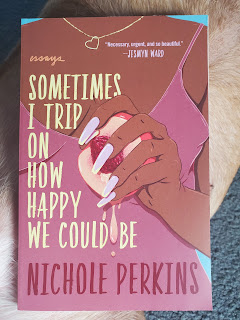
Sometimes I Trip On How Happy We Could Be: Essays by Nichole Perkins
 
I was introduced to Nichole Perkins through her guest appearances on a charming yet honest race, current events, and pop culture podcast called Another Round (thanks and RIP as of 2017). However, it wasn't until I became an avid listener of a different podcast called Thirst Aid Kit (thanks and RIP as of 2020) that I gained a good grasp of her voice and her writing. On Thirst Aid Kit, Perkins and her friend/co-host Bim Adewunmi explored how desire ("thirst") functions within pop culture, and what makes certain Hollywood men so thirst-worthy. My favorite segment was when, toward the end of each episode, Perkins and Adewunmi would compete by reading aloud the fanfiction-style "drabbles" they'd written, usually depicting imagined meet cutes or scenes of intimacy with the male subject ("thirst object") of the week. These drabbles were exquisitely written—sometimes adorably sweet, more often disarmingly hot—and knowing that Perkins already published a book of poetry and had a memoir on the way, I was excited to read more of her romance-related writing. Released in August 2021, Sometimes I Trip On How Happy We Could Be was the last book to arrive from my four-book Harriet's Bookshop order that I placed as a podcasting anniversary gift to myself last summer, and it's the third of the bunch that I can now say I've had the honor of reading in its entirety. (See also While We Were Dating and The Secret Lives of Church Ladies.) 
 
Though not in strictly chronological order, Sometimes I Trip features around 20 essays about Nichole Perkins's journey as a Black woman who spent her whole life from birth to undergrad in the South, and how she developed her sense of self as a culture critic and a deeply sexual person. She shares the facets of music, TV, and film that have profoundly influenced her understanding of desire and desirability, including Prince, whose 1987 song "If I Was Your Girlfriend" inspired the title of this memoir. (I'll go ahead and embarrass myself by volunteering that as girl who was born in the '90s and who respected Prince but wasn't in any way a committed fan, when I first saw the cover reveal for this book I initially assumed that the title referenced Beyoncé and Jay-Z's "'03 Bonnie & Clyde." Obviously Perkins, a Prince super-fan, learned me something in her essay dedicated to Prince, because of course she wrote one. It's titled "Prince's Girl." ) Additionally, Perkins shares about her family, growing up in Black Nashville, HBCU campus life ("HBCUs Taught Me"), social media/dating app culture, her complicated relationship with academia from New Orleans to Los Angeles to Columbus, her faith journey (deconstruction?), and her experience with depression and low self-esteem in her fluctuating body. And of course, as I've alluded to, there's much talk about sex. Not only in terms of some of the guys she's been involved with and why, but also in terms of how she's flipped the concept of being "fast"—an insult/warning against sexual activity or inviting sexual attention that's often hurled at young Black girls before we even get the chance to understand our bodies as our own—into a catalyst for coming into her own power. Whether as the girlfriend, the other woman, the casual hook-up partner or somewhere in between, with time and experience Perkins has learned to replace the potential shame of loving sex so much with pride in her ability to make men weak overcome, obedient, and well... thirsty. And that sense of power is bolstered by knowing what pleases her. For example, skinny men are high on her list because, apparently, skinny men got that hammer. Also, it's possible for cunnilingus to last for nearly four hours straight. Also also, her first time having sex occurred exactly four months before the day I was born. You learn something new every day.
 
As I tend to do with poetry, story, or essay collections, I marked the essays I liked most so that I could discuss my favorites here, but there ended up being too many for me to pick concrete favorites. So I'll just touch on the ones that stick out the most in my memory as I write this. "The Night I Took Shrooms" (where Perkins tries magic mushrooms in the presence of the white dude she's seeing at the time, referred to as "The Hippie") was revelatory, to say the least. It's a trip that goes from orgasmic to terrifying to guilt-inducing to orgasmic again, and in the end she proves to herself that she can dabble in recreational drugs without losing control or becoming addicted like her abusive father had. I was astounded by the candidness of "Scandalous," where she recounts a lengthy affair she carried on with a married man during her "ho phase"—even unintentionally becoming some sort of friends (?) with his wife—and essentially argues that the other woman isn't necessarily a bad person, that she deserves empathy too. That essay was a difficult one for me to digest, because her assertions that she shouldn't be held responsible for men's actions (as in, the mistress shouldn't be the only one blamed for cheating) and that she couldn't care more about her lover's wife than he himself did (as a response to the guilt of hurting a fellow woman by sleeping that woman's husband) aren't invalid, but still... I don't know. I guess it's the lack of remorse that rubs me the wrong way? She refuses to feel ashamed about getting hers, which I understand. But as grown as I supposedly am, the messiness of the situation was a little too grown for me.
 
On a different note, I was very much touched by the way "The Women" highlights some of the influential female relatives in Perkins's childhood. These include her great-grandmother Muh'Deah who combed Perkins's hair and shared a fluffy bed with her whenever she spent the night, her aunt C who took her on many a Saturday lunch/bookstore/wisdom excursion as a breather from the parental chaos at home, and her older sister Izzie whom she's always strived to emulate and comfort. Furthermore, her discussion of sexism in the church, being mad at God, and why she's still a believer but doesn't attend church anymore ("A Woman Who Shouts") was realer than real. And her retelling of how the procedural drama 'Bones' helped her crawl out of a depressive episode ("Bones, Depression, and Me") definitely struck a chord with me. There are only two essays I don't wish to revisit, and only because they're nightmarish accounts of boundary violation and rape. One is "Don't Take Roses Away from Me" (which involves a sex partner who stealths her, then stalks her after she ends things), and the other is "Call It By Its Name" (which involves her being raped by a male friend while incapacitated at a party, not being able to call it rape until 10 years later, and still keeping that person in her life in the present). They're definitely worth reading, even if only to honor Perkins's courage in publicly divulging such ordeals; I just don't think I can handle reading them again, is all.

I like Sometimes I Trip. I was hoping to LOVE it, given how much I've enjoyed Perkins's podcast work and online presence. But it's very clear that Perkins believes in romance and wants to be in a long-lasting committed relationship, and thus she writes about men a lot in this book. Granted, I fully knew to expect this, but for some reason it still felt like... a lot. Her writing about men so much isn't because she can't see herself outside of them (quite the opposite), but because being married to a worthy man is something she still genuinely wants so that she can express all the love she has to give. And instead of just waiting around until she finds The One, she gets it in in the meantime and has tons of stories to tell about doing so. Those are things I sometimes found hard to relate to as someone who simply isn't trying to be bothered with men like that, at least not right now. (My "I'm not like the other girls" phase definitely included turning my nose up at those who devoted what I believed to be too much of their brain space to boys. Even now with the ubiquity of dating and relationship discussions on social media, I resist the impulse to dismiss or judge but sometimes find myself wondering, Don't y'all have anything else to talk about?) But that has more to do with my own positionality; it's not a fault of Perkins's writing at all. Although I do enjoy escaping into the sensual and emotional scenarios that romance writing offers, I'm realizing that I'm not much of a romantic in real life. I almost wish I were, though, so that I could appreciate this memoir even more. Still, it's a very solid "like" for me! If you're interested in the experiences of Southern Black women, sexual exploration, book/TV/movie/internet references, liking what you like even if it's considered taboo or basic, or memoirs that get really personal, then read this book!
 
Favorite quotes:
"In adulthood, the names for sexually adventurous women were worse, but I still wanted to explore the power I felt when men shook in my arms... I chose to lean in to the desires pulsing through me, and maybe that's what saved me" (15).
 
"No, this tingling sat at the top of my spine, waiting for me to notice it, and when I did... I thought I heard a deep voice, which sounded like it was smiling at me, say 'I'm here'... I started to worry, until I realized maybe God didn't want anything from me at all. Maybe He just wanted me to know He knew who I was... it seemed like that was the answer and it was enough: I think I needed to now God knew I existed. Church made me feel lonely, but that sprinkle of the Holy Ghost let me know God knew me" (21, 23). 

"I made sure to rub my damp crotch all over the arms of her furniture. I hoped that whenever she napped on her sofa, she dreamed of Black women with big butts parading naked through her home" (58).

"We went to high school together but didn't become close until adulthood brought us back home in ways neither one of us expected. We bonded over the special misery you're in but not allowed to complain about when your plans go to shit and you come back home... people think you have nothing to do. We were also both creative women who tried to be 'good girls' when we're really magic" (213-14).

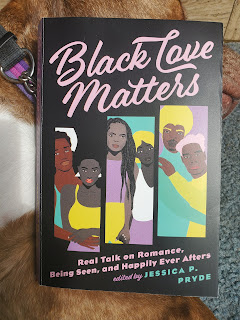
Black Love Matters: Real Talk on Romance, Being Seen, and Happily Ever Afters edited by Jessica P. Pryde
 
I met Jessica P. Pryde—a librarian and co-host of Book Riot's When in Romance podcast, among other things—virtually last summer. I was looking for potential guests for Young, Gifted and Abroad and returned to an old Twitter thread I'd found where tons of writers, including Jessica, had chimed in about their study abroad experiences. In late July 2021 I interviewed her about her time in Arezzo, Italy and we had a lovely conversation about that and her journey as a romance enthusiast. When I first looked through her website to prepare for that interview, I'd skimmed through info about her upcoming essay anthology called Black Love Matters being slated for release in February 2022, so I knew that it was on the horizon. However, the enormity of how significant this book was didn't set in until after I'd spoken to Jessica and looked even more into her work than before. (Sadly, I got caught up in the moment of the interview and missed an opportunity to ask her about the book itself.) From there, I was already sold on Black Love Matters because Jessica had edited it, but I was doubly sold when I discovered that one of the essays was written by Jasmine Guillory (the author whose work first set me on a path toward embracing romance novels at the end of 2019). So I ordered my copy in late January when I happened to learn that Barnes & Noble was having a 25% off preorder sale that week. BLM is not only Jessica's first book, but according to her "Acknowledgments" section it's also the first nonfiction book that Berkley Romance has ever published.
 
I have to say, more of the essays in BLM focused on historical romances than I was anticipating. Historical romance (historical fiction overall) is generally not what I'm into, but I appreciated reading the praises that multiple essayists sang to Beverly Jenkins—who is stunningly thorough in "A Short History of African American Romance", and who is the "queen of the Black historical romance" according to fellow essay contributor Piper Huguley. And how could I not be moved by contributors' passionate and well-substantiated arguments for Black love throughout the centuries (yes, even during slavery times) deserving more attention, research, and care in romance novels set in the past? It's not "inaccurate" to acknowledge Black people loving each other and guarding their love fiercely in places and time periods where many don't believe them to have existed, or to have been capable of knowing love at all.
 
As for favorite essays, I've got a few. First off, I didn't realize until after reading Carole V. Bell's "I'm Rooting for Everybody Black: Black Solidarity, Black World-Building, and Black Love" that I was already following her on Twitter, and now I feel wonderful about that choice because Bell sure knows how to analyze the mess out of a book! She calls Black romance "the literature of hope and progress", and of the three books she focuses on I was very nearly sold on How to Catch a Queen (Alyssa Cole), thanks to Bell expertly parsing out how Black solidarity and social justice are integral to the main couple's HEA (Happily Ever After). And I actually was thoroughly sold on I Think I Might Love You (Christina C. Jones); the excerpts Bell includes from it are excellent in getting the novella's sense of humor across, so I'll definitely be reading that one. Also, I'm so delighted to have now been introduced to Sarah Hannah Gómez through "Romance Has Broken My Dichotomous Key"! Her analytical yet accessible and blunt yet compassionate writing style, her hilariousness, and our similarities in personality made me almost say aloud while reading, "Ooh. I like you." I kid you not, my notes in the margins of her essay included, and I quote: "Holy crap. Are you me?" (re: being resistant to reading romance and then changing her mind), and "Oh girl. You and I were the same child" (re: deciding in grade school that age-appropriate books were too immature, and casting those aside for adult books in order to seem more impressive to others). Gómez's essay is a true joy, offers phenomenal insight into academia/libraries/publishing, and is the one that I'm still thinking about most.

Another favorite is the essay Jessica wrote herself, "Interracial Romance and the Single Story". I respect the self-awareness with which she, a Black woman married to a white man, examines the predominance of Black romance characters being involved in interracial (especially Black woman/white man) relationships. She draws attention to a concerning trend where mainstream American media and their consumers would rather see "half a Black couple instead of a whole one." I've mentioned in previous reviews about how so far I've chosen to read romance novels that feature two Black people (or more than two, shout-out to Harbor) falling for each other. And being a person with no romantic experience who doesn't spend much time thinking about "Black Love" outside of the romances I read, I still haven't been able to articulate why this reading preference of mine persists. (Other than it possibly being a holdover from my attempts to limit white infiltration into my life via the media I consume as a trauma response to 45 being elected in 2016. That's another story for another day.) But since searching more earnestly for steamy reads that'll be up my alley, one thing I've noticed is that in American romance novels, most of the male love interests seem to be white men, and I can admit that this bothers me. Because it's like, why are white men the prize? Do they deserve love more than any other variation of man out there? 
 
I've seen glowing online recommendations for romances written by Black women and other women of color, but when I look up some of those authors' work and see a white man framed as The Guy in most or all of their books, it gives me pause. I don't take offense to interracial relationships at all, it's just that the prevalence makes me wonder, Why do you specifically desire white men so much, sis? What's with this fixation? Of all the dream men you could've conjured up to write about, why are so many of them white? Some of it's a consequence of the industry, as Jessica explains that having a prominent white character makes a story more likely to be produced or published in the mainstream, and more likely to be marketed well and thus sell well. But still. Obviously this is my own hang-up, and my intention isn't to cast judgment, especially not with me being relatively new to valuing the genre. My point in saying all this is simply that I appreciate Jessica's essay for making me feel like I'm not crazy for noticing what I've noticed. In her summation, it's not that portrayals of interracial romance are a negative thing; it's that they shouldn't eclipse Black romances just because they're a convenient way for publishers, production companies, and consumers to appear diverse without confronting their discomfort with Black lovers loving each other. And color me elated when Christina C. Jones further echoed my sentiments in her essay, "Black Indie Romance", which is the final full essay of the anthology. I love the way she breaks it down, "I asked for blue. Purple is fine. But it is not blue." (See my favorite quotes below for the full quote.) Jessica gets it, and so does Christina!
 
Last but not least, I can't say that "(Black) Love Is... (Black) Love Ain't" is one of my favorites in terms of enjoyment, but I also can't deny how thought-provoking it is in acknowledging the ways non-conventionally beautiful people get left out. The guts! The guts with which Da'Shaun Harrison refutes the notion that Black Love is revolutionary, because it's still largely reserved for people and characters who are deemed to be conventionally desirable according to white supremacist standards ("Black people who are thin, light-skinned, non-disabled, cisgender, heterosexual, Christian, and/or moneyed"). They go on to argue that the concept of Black Love as we call it, as shaped within the prevailing anti-Black world's definition of "love", is neither possible nor something we should want because it's a concept that continually harms and fails us. Which is a downer, sure, and not an argument I can say I fully agree with at this time. But as someone who falls under multiple categories of undesirability just like Harrison does, I think it's impressively bold to declare that Black people loving each other is necessary and worthwhile for community-buidling's sake, while still pointing out the flaws in believing that Black Love in and of itself will save all Black people from the ills of this world. I respect that boldness.

So, with all that being said. If you are looking for greater context on how Black romance writers and Black romantic characters fit within the history of romance as a genre, want book or author recommendations, want to know why romance novels should be taken seriously (and why some people in romance won't be begging you to take them seriously either way), are curious about how Black romance writers and enthusiasts got their start in a similar style to the Well-Read Black Girl anthology, or simply want to support a Black woman's first book, then read this essay collection!

Favorite quotes:
"I have done what people who look like me often do; I've found slivers of myself and constructed my own belonging in that mosaic, and I am better for it. But queer Black readers of romance should not have to piece themselves apart for the tiniest bit. They should be able to walk into a bookstore and be spoiled for choice. And the next time some tired student needs a release from her coursework, she should be able to find more options to build a queer Black girl TBR than she reasonably has time to read" (Nicole M. Jackson, 76-77).
 
"How can Black Love be the entity that creates room for Black subjects to love, with all its limitations, if the Black fat is excluded? If the Black queer is reduced only to sex and not their ability to be intimate in myriad ways? If the Black trans person can only ever be a fetish one takes part in and not a living being one gives love to? What is the utility of Black Love if disabled persons are requested, or demanded, to 'cure' or hide their disabilities?" (Da'Shaun Harrison, 214).
 
"...Black romance gets pushed out. And we're expected to accept it as representative of something it is not. I have not, am not, and will not argue against interracial relationships having their time in the sunthose relationships are just as important and valid as any other.

What I don't accept, though, is being inundated with purple when I asked for blue.
Purple is fine.
But purples is not blue" (Christina C. Jones, 226).

 "I can probably guess who I might be without you, but I don't care to ever find out if it's true" (Jessica P. Pryde, 239).

Thursday, December 30, 2021

BOOKS! (Harbor + The Secret Lives of Church Ladies)

Well, what do you know? Look at me writing two book reviews in one month! For the holidays I've been chilling in Louisville, and my only real goal for these last few lingering days of December has been to write another book review before "this year" becomes "last year". So here I am doing just that! This review features two novels, each of which I read cover-to-cover in two days, and one of which is the last book I'll be finishing in 2021. Both of them were written by Black women and both contain romance in varying degrees of graphic detail. First up is a very NSFW romance novel about a polyamorous relationship that forms between three Black 30-somethings who've lost their significant others in the same murderous incident. And then, a collection of stories about Black Southern women who grew up in church yet find themselves bucking tradition in favor of desire, self-discovery, and doing what they want simply because it feels good. 

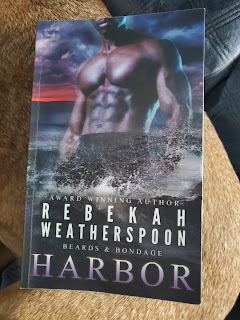
Harbor by Rebekah Weatherspoon
 
I'm not going to divulge the real reason why I chose to read this book, because I don't want to tell on myself (at least not any more than I already have in nearly 9 years of keeping up this personal blog, amirite?). So I will just say... previously I've mentioned how I became aware of Jasmine Guillory because her name seemed to be everywhere in the online spaces I frequented around 2019, which made me want to know what the hype was about. I found out about Rebekah Weatherspoon, another Black woman who writes romance novels, in much the same way. And when I looked through Weatherspoon's bibliography, Harbor (part of her "Beards & Bondage" trilogy) seemed to be her most prominent example of a romance between Black people. But not between just two Black people, oh no. Three. Harbor is a standalone novel and also the third and final part of what Weatherspoon calls, "This sort of bizarre, extremely horny romantic suspense trilogy" in her very succinct thank-you paragraph at the end. In this review I will occasionally refer to the book's characters by their first initials: VS = Vaughn and Shaw. CVS = Corinne, Vaughn, and Shaw. VBS = Vaughn, Brooklyn, and Shaw.
 
Vaughn is a patent and trademark lawyer living in Boston, and his boyfriend Shaw lives on Cape Cod crafting custom wood furniture for wealthy clients. Brooklyn, a Bronx native, is an assistant district attorney living in Brooklyn. There's no reason for VS and Brooklyn's paths to cross, until VS's girlfriend Corinne and Brooklyn's fiancé Josh are killed in a double murder-suicide—Corinne was being stalked, and the stalker killed her and Josh while they were in bed together. In other words, Brooklyn and VS learn of their significant others' deaths and their infidelity at the same time. Blindsided, they each mourn their dead lovers while nursing their anger at being lied to and cheated on. (From the little I've learned thus far about polyamorous relationships, being polyamorous doesn't necessarily mean that partners can have sex with whoever else they want, whenever they want, and without discussing it first. Every relationship is different, and poly partners often have their own agreements and boundaries set in place. For CVS, being polyamorous meant that they were all in a committed relationship with each other, and so Vaughn and Shaw rightfully feel betrayed by Corrine's secret involvement with someone else.) 
 
Feeling emotionally raw and desperate for answers, Vaughn seeks Brooklyn out at Josh's funeral, and they agree to meet at a Boston hotel with Shaw reluctantly in attendance as well. Although Shaw doesn't initially think any good can come from this meeting, and the concrete answers that Vaughn and Brooklyn seek will elude them forever, the trio find unexpected comfort in each other since only they know exactly what it's like to be dealing with this uniquely messed-up predicament. And although VS are attracted to Brooklyn and vice versa—while in Brooklyn's hotel room, they all acknowledge that each one of them is foine—the three agree that the loss is too new, and that they're too close to the situation to become sexually involved with each other so soon. They don't want to "trauma bond" (at least not yet), so Brooklyn and VS go their separate ways, but not before Shaw returns to her room to make out with her a little bit. Sixteen months later, Brooklyn randomly texts Shaw about just having "the worst sex of my life," and Shaw invites her to spend a weekend at his house on the Cape so that he and Vaughn can rectify that for her. Thus begins Brooklyn's introduction to Vaughn and Shaw's BDSM lifestyle, which includes a secluded beach, Shaw's sex dungeon, and agreed-upon terms and conditions.

While Vaughn is the one to initiate contact with Brooklyn and he technically has sex with her first (at Shaw's instruction), to me Brooklyn and Shaw still seemed to have a more intense connection between just the two of them. What Corrine did is clearly called "cheating", but when Shaw visits Brooklyn alone and kisses her, that's not considered crossing a line, and I was confused about that. V knew S was going to visit B's hotel room again, and V knew S probably wasn't going there just to talk, but it's not clear whether V and S discussed the kiss afterward or not. Additionally, there are two occasions where B and S play without V (one occasion V knows about and is partially present for via FaceTime, the other one he's completely left out of and doesn't know about until after the fact). So jealousy is briefly addressed within VBS's arrangement, but it wasn't always clear to me what counted as boundary-crossing for them and what didn't. 
 
There's an obstacle that's somewhat randomly thrown in to manufacture what I now understand to be a common or even expected trope in romance story structures: The couple (throuple?) break up or otherwise separate in the third act, making it all the more rewarding and meaningful when they manage to find their way back together again by the story's conclusion (happily ever after/happy for now). One of the detectives investigating the double murder-suicide shockingly rolls up on VBS when they're at brunch during one of their kinky weekends on the Cape, and he clearly questions and disapproves of VBS being together. This scares Brooklyn and VS into ceasing contact so as not to raise further suspicion and potentially be treated as suspects in the case. However, that obstacle arises and disappears in a matter of 13 pages (I counted). The more important conflict lingering from that scare is B and VS needing to admit that they want more than just sex with each other; they want to be a polyamorous "unit", even with the emotional and professional risks that come with being committed to (and public with) such a relationship. For Brooklyn in particular, who's new to this and whose career would be most at stake out of the three, the run-in with the detective forces her to decide whether she's willing to break norms and potentially be exposed in order to pursue love with these two men.
 
Speaking of their love, I would've liked to read more of VBS's relationship after they made up, like how they grew to further understand each other's likes and dislikes (one more play scene wouldn't have hurt). We go from them reconciling on Brooklyn's sister's farm to them having a commitment ceremony—as close to a wedding as they can get, since their union won't be legally recognized—on that very same farm 16 months later. And Brooklyn does recap the major happenings of that in-between time, but I wanted to know more of the details. For example, there's a specific act that B keeps thinking about once she and VS first start doing their kink stuff together, and she finally gathers the nerve to request it, only for S to insist on delaying it until the three of them have discussed all the health concerns related to it. Which I thought was excellent! A thoughtful approach to doing-the-do safely. Wonderful. But then it never comes up again. I'm sure that over the 16-month course of this trio's revived relationship leading up to the commitment ceremony, B got to experience the act that she wanted done to her, but it just seems strange to keep mentioning something, as if the reader is being primed to look forward to it, and then never actually show it happening.
 
I learned so many new things from reading Harbor, and one of them is a potential reason for why some folks prefer poly relationships in the first place. This was fascinating to me because as an introvert with no romantic experience, being in a relationship with multiple people at once is not the first idea that comes to mind when I think about dating. And admittedly, in the past I did entertain the heinously ignorant supposition that bisexual, pansexual, and/or polyamorous people might simply be indecisive or greedy. But thankfully, Vaughn helped me consider that there are some people who overflow with so much love and affection that they can't help but want to share it with as many others—selected and vetted others, in Vaughn's case—as possible. Furthermore, if that's the case, then perhaps it's necessary to share one's affection with multiple partners, rather than risk smothering one partner with all of that love and the needs that come attached with it. That's an idea that had literally never occurred to me before, and through Vaughn, Rebekah Weatherspoon presents it in a way that makes perfect sense.
 
Something else that I find brilliant about Harbor is how it contests whether bonding over trauma is really so dangerous if the parties involved prioritize honesty at every step. The novel contains lots of talk about feelings, as VS and VBS are constantly checking in with what each person needs or wants in the moment. "What do you need?" is a question that is asked quite frequently. Brittany, Vaughn, and Shaw are each recovering from the trauma of death and infidelity as they probe the potential of this new entanglement, and they want to take care of each other while still processing their respective emotions as authentically as possible. Not too long ago, I read a Korean webtoon called "Ouroboros" (by Songhyel) that was somewhat similar to Harbor in framing polyamory as a means of exploration and healing amidst PTSD. A cop is abducted, held hostage for days, and repeatedly raped by his brother-in-law, and after losing his wife and being suspended from his job, he starts dating a younger colleague and a rich heir/party boy at the same time. And what you assume is a love triangle gradually morphs into a poly situation where the colleague and the heir's respective desire to have the cop to themselves takes a backseat to them collaborating to support the cop through the trauma responses he's exhibiting. In hindsight, I'm glad that I read that webtoon before arriving at Harbor, because it enabled me to approach the novel with a more open mind. If you're curious about kink/BDSM, recovery from loss, and how a polyamorous relationship might play out between 30-something Black professionals, then read this book!

Favorite quotes:
"But none of that is going to happen 'cause as it turns out this motherfucker was cheating on me... and I can't even take this giant diamond ring off my finger and throw it in his face, because he's dead" (15).
 
"I can want good things for myself. I can want real happiness. I can want whatever the fuck I want. If I want sex to be a part of my life again, why wouldn't I want it to be good? No use in wishing for mediocre" (71).  

"On top of that, she's a plus-size Black woman. How many times a day do you think she's getting some messaging that she's undesirable? Fifty? A hundred?... So, I think it makes sense that if we want her to be with us in any long term way we prove to her that we aren't using her and that her needs and her very real fears are being met" (151).
 
"Trust me. It's part of the process. You've done the mourning. It's time to do something stupid. It's another signpost on the road to better health" (205).

"You don't have to apologize for getting off" (210-211).

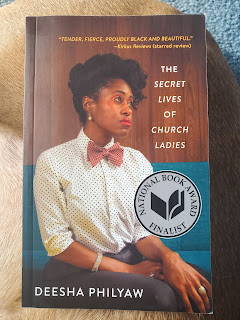
The Secret Lives of Church Ladies by Deesha Philyaw
 
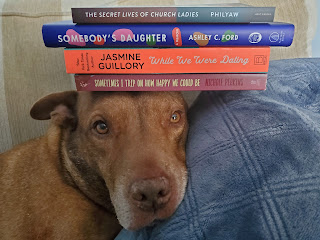
I've been hearing about this story collection almost nonstop since it was published in 2020; people have been raving about it, and apparently it was a surprisingly huge critical and commercial hit for West Virginia University Press (a relatively small publisher). With the beginning of summer 2021 came my copy of The Secret Lives of Church Ladies, one of four books that I ordered from Harriett's Bookshop in Philadelphia as a 3rd podcast anniversary present to myself, thanks to a gift card from my very generous friend Marlee. (See also While We Were Dating.) I called myself starting to read it in November, but set it aside, then re-started it on Christmas Eve, and finished it the day after Christmas. Also, I would like to add—purely for bookworm and slight fangirl purposes—that I posted this photo of my dog Julia with my Harriett's purchases on IG (see the bottom of this review), tagged the authors of each one in said photo, and Deesha Philyaw followed me as a result! That was on August 20th, and as of this writing she's still following me! How cool is that? I've never had a famous author follow me before. But let's stay on topic. Moving on!

In nine stories ranging from the 1980s to Y2K Eve to the present, Black Southern female characters (ages 14 to super grown) narrate their romantic and sexual discoveries. They give into temptation with intention, hone in on the desires of their hearts, and amend or discard the limiting beliefs they learned from growing up in church as need be. From two closeted 40-year-old teacher besties having an annual New Year's Eve date-night-in at a hotel far from home, to a real estate agent entertaining her man friend while her Eddie Levert-obsessed and dementia-diagnosed mother sleeps in the next room, every story in TSLOCL makes some direct or indirect mention of women getting it on, enjoying sexual pleasure even in taboo or supposedly forbidden situations. In fact, seven of the nine stories include characters who sleep with married men, or used to. (There's even a story titled "Instructions for Married Christian Husbands", which is one woman's detailed set of stipulations that married men must agree to before she allows them to have sex with her.) Such characters are not "chosen" in the way that Black women are conditioned in church to value being chosen, but then again, becoming someone's wife isn't an objective that they've based their entire identities and personalities on anyway.
 
Of the stories, an undeniable standout (and the source material for the book's peach-focused 2022 UK cover) is "Peach Cobbler". Marvelously, it uses a girl named Olivia innocently confusing the local pastor for God—the married Pastor Neely to whom her mom secretly provides both culinary and carnal sweets for over a decade—to examine how often grown church ladies also treat their male church leaders like God, and how silly that is. Olivia's mom even treats Pastor Neely as if he's the head of her own household, letting him hit it once a week, not allowing Olivia to badmouth him or ask questions about his presence in their home, and making a peach cobbler every week (EVERY WEEK!) that only he gets to eat when he visits, otherwise it gets thrown in the garbage. The titular peach cobbler works as a metaphor or stand-in for, to put it most plainly, pussy. ("My mother's peach cobbler was so good, it made God himself cheat on his wife", "You got the best cobbler in the world right here", and so on.) Peach cobbler also represents sweetness, something that Olivia's mom intentionally deprives her of. Whether that sweetness be a taste of the dessert her mom expertly makes, or permission to attend her wealthier classmate's birthday party, or her mom being a little softer with her sometimes, Olivia mustn't grow up expecting too much from life. Or so her mom asserts.
 
Come to think of it, Olivia and her mother remind me of Dana and her mother Gwen from  Silver Sparrow (Tayari Jones), wherein Gwen welcomes Dana's polygamist father to her home like a king once a week while Dana is expected to stay in a child's place, abiding by this arrangement and not revealing their existence as her dad's secret second family to anyone. Gwen at least cares a bit more about how her relationship with her man impacts her daughter. But Olivia's mom doesn't seem concerned at all about the uncomfortable and unfair circumstances that she's forced her daughter into, practically screwing the pastor right under Olivia's nose, well into Olivia's teenage years! And just like I did with Gwen, I tried and failed to not judge Olivia's mom for her choices. Granted, I've never been "sick with desire" or taken under by it, as Olivia describes her mom in the story. So maybe I just don't get it due to lack of experience. Maybe it's just something about certain Black women of a certain age from a certain time period (much of the action in both Silver Sparrow and "Peach Cobbler" takes place in the 1980s and early 1990s, in the South). But come on! What kind of subservient behavior are these characters modeling for their daughters, prioritizing men's pleasure and security over their own just to hold onto a fraction of said men's time and attention? Don't mothers owe their daughters better than that? Lord have mercy, did "Peach Cobbler" blow my socks off and horrify me at the same time.
 
Despite the amount of time I've just spent addressing "Peach Cobbler", my favorite story in TSLOCL is actually "How to Make Love to a Physicist" for the same reason that my favorite story in Love in Color (Bolu Babalola) was "Thisbe". It's about a plus-sized Black woman finally learning to feel more at home in her body, while taking hold of the fulfilling kind of love and physical intimacy she's just now realizing she deserves. Extra points for this particular Black woman (Lyra) working with a therapist to overcome her self-sabotage—she and the handsome physicist she's met at a STEM conference are feeling each other, but she ghosts him twice—ditching the girdles and the sucking-in that her super religious mother has always insisted on, and being a late bloomer at owning her curvy and jiggly body at 42 years old. With all that said, "Peach Cobbler" is definitely a close second favorite. And my goodness, these character names! Caroletta, Tasheta, Arletha, Mayretta, Kachelle, Timna, Lajene... and those are just the names I'd never heard of. Others I'd heard before but hadn't anticipated seeing in print, attached to characters in a much-publicized, much-nominated, and much-awarded novel like this one. Now that I have, I couldn't be more delighted. Another delight was recognizing quite a few names that Deesha Philyaw listed in her acknowledgments, and I was most pleasantly surprised to see Bassey Ikpi (I'm Telling the Truth, But I'm Lying) and Melanie Dione mentioned. Before I realized they were writers and also friends of TSLOCL's author, I was first introduced to them both via podcasts (Bassey on the "This Too Much" spin-off from The Black Guy Who Tips, and Melanie on The Bad Advice Show).

Earlier this week I encountered an application question asking me to talk about a Black woman, femme, or non-binary person I've learned from, and I impressed myself with my response, so I'm including it here to conclude this review:  
Speaking of The Secret Lives of Church Ladies, there is one story called "Eula" where Deesha Philyaw likens cunnilingus to prayer, and another called "How to Make Love to a Physicist" where she likens consummation to consecration, and I have never read the sexual and the spiritual juxtaposed in that way before, the way she does it. I no longer subscribe to the purity culture I was raised in, but I was still surprised to read the comparisons that Philyaw made. I am still thinking about those comparisons, and I feel myself being challenged to more deeply contemplate sex—especially unmarried and non-heterosexual sex—as sacred and holy.  
If you've ever questioned the faith you were raised in (especially its rules about what women and girls  should or shouldn't be doing), longed for someone to love you back, wanted to act on your desires without being judged, or if you want to read these stories before they're adapted into an HBO show written and executive produced by both Deesha Philyaw and Tessa Thompson, then read this book!
 
Favorite quotes:
"Do you think God wants you, or anybody, to go untouched for decades and decades? For their whole lives?... all those women at church who think they have to choose between pleasing God and something so basic, so human as being held and known in the most intimate way. If God became human once [then] why would he make rules that force such a painful choice?" (9-10).

"Closed mouths don't get head!" (25).
 
"'So you don't have to worry, anymore, Mama,' I said, 'about me wanting to be anything like you. I swear, my life won't be anything like yours. Because it will be sweet, and it won't be crumbs'" (74). 

"I say all of this to say that sometimes wheels are set in motion long before the spark is manifest. Is that the same thing as fate? I don't know, but I do know that rare, brilliant events take time" (113).

"You, the infantilized husbands of accomplished godly women, are especially low-hanging fruit. Ripe for the picking with little effort on my part... I build monuments to my impulses and desires on the backs of men like you" (146, 153).

"You're not a nobody, Mama... You're... someone who can't give me what I need. But you're not nobody" (174).

Wednesday, March 31, 2021

BOOKS! (Kim Jiyoung, Born 1982 + That Hair)

I made my first book purchases of 2021 earlier this month (stepped foot inside a B&N and everything), and fittingly, those purchases are the focus of this review! In addition to being two of the first three new books I bought this year, today's selections were both translated into English from other languages and published in 2020, and they're also books which I wasn't altogether blown away by but still appreciate for existing. First up is an international bestselling novel about a South Korean woman's debilitating lifelong experiences with sexism and misogyny. Then, a winding novel about an Angolan-Portuguese woman in Lisbon grappling with her curly hair and family history. And coincidentally, both of the protagonists of these novels were born in the year 1982!
 
Kim Jiyoung, Born 1982 by Cho Nam-joo
(Translated from Korean by Jamie Chang)

I can't remember exactly how I first found out about this novel. No doubt I noticed the online hype and praise surrounding its release in the States last year, and I know for sure that my friend Irene read it and we briefly chatted about that fact. But I usually like to pin down exactly how or where I initially hear about the books I read so I can remember why I've chosen to read them, and in the case of Kim Jiyoung, Born 1982, for some reason I simply do not remember. At the very least, this novel was high enough on the to-buy-eventually book list on my phone that when I spotted it while scanning the B&N shelves, I recognized the title right away and grabbed a copy. 

The book opens in 2015 ("Autumn 2015"), when the titular Kim Jiyoung, a 33-year-old marketing professional turned stay-at-home mom in Seoul, starts acting in a way that makes her husband Daehyun fear there's something seriously wrong with her. Jiyoung begins talking to her husband as if she's other peoplewomen like her mom and her deceased college friendtaking on their speech patterns and mannerisms in a way that goes beyond mere impersonation. Daehyun shrugs it off at first, but when Jiyoung's new behavior embarrasses him in front of his family during Chuseok festivities (in American terms, he basically blames her for ruining Thanksgiving dinner), he arranges for Jiyoung to see a psychiatrist. The next four chapters recap Jiyoung's life and the inescapable multitude of ways in which she's observed (or experienced outright) how boys and men are prioritized over girls and women throughout each stage of her development. From her mom's sacrifices to Jiyoung being a middle child and an elementary school student ("Childhood, 1982-1994"), to Jiyoung's middle and high school years ("Adolescence, 1995-2000"),  to her college years and the first and only job she ever has ("Early Adulthood 2001-2011"), to becoming a wife and quitting her job to be a mother ("Marriage, 2012-2015"). After laying out Jiyoung's life story, the novel ends with a sixth and final chapter that's set during the year after Jiyoung begins therapy ("2016"). 
 
Jiyoung's early adulthood is what has resonated with me the most, probably because me being in my 20s makes that chapter the most immediately-relatable of her life phases. But it's also because of how disgusted I was by the rampant sexual harassment and workplace discrimination that Jiyoung and countless working women like her are expected to withstand (or even accommodate), just for the sake of being considered worthy of employment. And that's IF they can even get hired in the first place. Jiyoung's one of the lucky ones who gets a job straight out of college, and has a female boss who's gone out of her way to improve working conditions for women at that particular company, but Jiyoung still ends up dealing with pervy clients and watching her less-qualified male colleagues get a promotion that she deserves. The painful twenty-something disillusionment that overtakes her is something I know all too intimately. Later on after leaving the job to give birth and raise her daughter, Jiyoung hears from a former colleague about an incident involving spy cams that traumatizes all of the female staff, and reading about that made me want to break things.

Jiyoung is done dirty in numerous instances, but the way she's persuaded (weaseled, suckered, brow-beaten, worn down, take your pick) into giving up her career to have a baby really boils my blood. Before having their daughter, she and Daehyun have a serious conversation about whether they want kids or not and it's very clear that Jiyoung has more misgivings about it than anything; motherhood is an idea that's being thrust upon her, not a role that she actively wants at that point in time. And that discussion goes unresolved, but then she's pregnant in the next scene! It's as if the objections she raises during that prior conversation and whatever anticipatory guilt, anxiety, and stress Jiyoung feels about everything she may lose by becoming a mom... none of that matters anyway. None of it was ever going to make a difference. Daehyun's family wants her pregnant, Daehyun himself wants her pregnant (although to his credit, he's just a hair less overzealous and pushy about it than his family is), and so pregnant she becomes. But then being a mom brings her public derision that she's unprepared to handle.
 
Something that kept bothering me is that we never learn why Jiyoung is with Daehyun. At least with her previous two boyfriends before him, we know about the dates they go on and other romantic aspects of Jiyoung's relationships with them, as well as what about each boyfriend makes Jiyoung fancy them. But all we know about her and Daehyun is that they met at her now-deceased friend's wedding reception. We get very scant details of their relationship prior to engagement and marriage. No dates, no romance, no proposal, none of Daehyun's redeeming qualities. He's her husband at the beginning of the novel, and he's already her fiancé when he appears in the "Marriage, 2012-2015" chapter, and that's all there is to it. Which kept making me wonder: Jiyoung, why are you with this man? Something else I'm realizing just now as I write this review, is that sex is not discussed in the novel. There's mention of the pressure to have children, how much periods suck, the trials of pregnancy, sexual harassment/assault, and even an abortion that one of Jiyoung's relatives has, but the act of sexual intercourse and how Jiyoung feels about it aren't discussed at all.
 
When I read in the beginning about Jiyoung's behavior suddenly changing and her husband being perplexed about why it's happening and what to do about it, I immediately thought of Han Kang's The Vegetarian. (A Korean novel in which, rather than pretending to be other people like Jiyoung does, the female protagonist refuses to eat meat and then eventually stops eating altogether.) I wondered if Kim Jiyoung, Born 1982 would go in a similar direction as The Vegetarian, revealing Jiyoung's current behavior to be the result of the mental trauma caused not solely by one specific incident, but by a lifetime of being undermined and disregarded in a sexist society. I found no delight and only sorrow in realizing that I was correct. 
 
Then I arrived at the last chapter ("2016"), where's it's revealed that the entire book is actually a collection of therapy notes! The contents are all observations about Jiyoung that her male psychiatrist has recorded based on what Jiyoung and her husband have told him in their sessions. So it's not that the book is oddly written (as I began to suspect due to its tone), but that the narration takes on the somewhat formal style of the psychiatrist, digging deep into his vulnerable patient's personal life and memories while remaining respectfully detached from the patient herself (a detachment that's compounded by his lack of experience living as a Korean woman). Maybe it was obvious to other readers that the book is written from the psychiatrist's perspective, but I was genuinely surprised. It felt like a huge reveal to me. And at first I thought the psychiatrist would be one of the good ones, so to speak; he's a man who gets it, or at least is closer to empathizing with the plight of women than most other Korean men (as depicted) seem to be. I hoped that Jiyoung would be in good hands. But then those last two paragraphs of the novel showed up like a punch in the gut, like salt rubbed into the wound of righteous indignance (dare I say rage?) that this book had already opened up in me. I won't spoil what exactly he does or says to reveal his true character, but I'll just say that if this is the best Jiyoung has access to as far as mental health support is concerned... she might not ever get truly well.

Now. Given the intense wave of simultaneous praise and outrage that pushed Kim Jiyoung, Born 1982 into international bestseller status after its initial 2016 publication in South Korea, I buckled myself in to read some quality man-thrashing! The back cover declares that this is "the global sensation that ignited South Korea's new feminist movement," and I heard that plenty of men were upset about its popularity, so surely there would be some man-thrashing involved? Right? Not exactly. The book does pay careful attention to the daily horrors of living as a girl or woman in a way that frequently made me feel afraid, angry, and disheartened for Jiyoung. But overall, it's fairly tame in the man-thrashing department. Cho Nam-joo matter-of-factly portrays the average Korean woman's experience as she knows it, and if anything she tempers the egregiousness of those daily horrors by using a male narrator to convey them. So I definitely get why the book has been such a huge hit, but I don't get why men have been so offended by it. Maybe it was the timing of the publication, and maybe I'm missing something because I'm not Korean and don't read Korean. In any case, this is certainly a read that I would recommend! If you're interested in understanding Korean women's hopes and disappointments along with the countless nuances of Korean mothers' sacrifices, but you don't necessarily want something that will make you collapse into a puddle on the floor like Please Look After Mom and If You Leave Me almost did to me (which also came to mind as I read this), then read this book!
 
Favorite quotes:
"Besides, I don't know if I'm going to get married, or if I'm going to have children. Or maybe I'll die before I get to do any of that. Why do I have to deny myself something I want right now to prepare for a future that may or may not come?" (60).
 
"Disappointment collected between them like dust on top of the refrigerator or medicine cabinetspots clearly visible but neglected... Onto the feelings left unsaid for so long that they were desiccated and crackling, a tiny spark of a flame fell and instantly reduced the most shining romance of youth to ashes" (107-8). 

"The world had changed a great deal, but the little rules, contracts, and customs had not, which meant the world hadn't actually changed at all" (119).

"Help out? What is it with you and 'helping out'? You're going to 'help out' with chores. 'Help out' with raising our baby. 'Help out' with finding me a new job. Isn't this your house, too? Your home? Your child? And if I work, don't you spend my pay, too? Why do you keep saying 'help out' like you're volunteering to pitch in on someone else's work?" (131).

That Hair by Djaimilia Pereira de Almeida
(translated from Portuguese by Eric M. B. Becker)
 
Same with Kim Jiyoung, Born 1982, I have no recollection of how or when I first heard about this book. I just know that I decided to buy it at some point—probably because I wanted to learn about Angola and Portugal from the perspective of the Black woman who wrote it, plus the only other novel I've read about Portugal is Alentejo Blue—and it was on my book list for many months. Fun fact: This is the first book I've ever read whose translator I've actually met! When I was in the running for an editorial fellowship with an international literary magazine last year, Eric M. B. Becker was one of the people who interviewed me. That interaction had absolutely no influence on my desire to read this novel, since I knew about That Hair before I knew that Becker existed, but it's a funny little coincidence that I was looking forward to sharing in this review.

Situated on the west coast of south-central Africa, what's known today as Angola was colonized by Portugal for 400 years until independence in 1975, and the impact of colonization is embedded in main character Mila's family history and physical features. Her most visible and commented-on feature being her naturally curly hair, which sticks out and up rather than flowing downward. She's a biracial woman with an Angolan (Black) mom and a Portuguese (white) dad, who was born in Luanda (the capital of Angola) and then raised in Lisbon (the capital of Portugal) from the age of three. Colonial relations are what makes it conceivable that both of her parents are "from" Africa: her dad was born in Mozambique when that was also still a Portuguese colony, was raised by Portuguese parents who considered Africa to be their home, and he met Mila's mom after moving to Luanda as a young adult. Mila moves to Portugal with her dad in 1985, and by the mid-1990s most of her family on both sidesincluding her Angolan grandparents but not including her motherare living in or around Lisbon. Mila mostly grows up with her Portuguese relatives, though she has a tender fondness for both sides, especially all four of her grandparents. She sees her mom during summers when either she visits Angola or her mom visits her in Portugal. (No mention is made regarding the circumstances of her parents' divorce or her mom's decision to remain in Angola.) In this novel that's framed as Mila's attempt at autobiography, her yearning to know more about her Angolan roots and her desire to make sense of her hair journey feed into each other.

It's not that I wanted this to be exactly like, for example, 'Nappily Ever After' (of which I've only seen the Netflix movie adaptation and haven't read the book it's based on). But I suppose I was expecting That Hair to be its own version of that now-quintessential, heartfelt, even humorous story of a Black woman learning to embrace herself through her hair, albeit written in a more sophisticated way and in a Portuguese context. And while Mila does pepper in anecdotes about unsuccessful at-home and in-salon attempts to style her hair, the comments she fields from relatives and strangers alike, and how frustrations with her tresses affect her sense of self... this book doesn't actually center around Mila's hair. It's more about her family and how she memorializes the people in her life (including her ancestors and herself), with frequent mention of her hair as a guiding motif. Reading That Hair actually reminded me a lot of Michael Ondaatje's fictionalized memoir Running in the Family, which also features multiple generations of a mixed family connected to a formerly-colonized country of Brown people (Sri Lanka).
  
I'll just make it plain and say that I wanted to enjoy this book more than I did. Something about the writing took me out of it. Though I do appreciate that Becker's translator's note at the beginning provides a heads-up about this, explaining how Portuguese writing "is many times more permissive of and malleable to discursive detours, repeated pivots, and elliptical flights of lyrical fancy, all in the same phrase" (xiii). Knowing what to expect did make the book smoother to get through. And while I was impressed by much of the novel's poetic phrasing, I'd venture to say that That Hair probably wouldn't be a good choice for someone who gets lost when reading heavily-descriptive or winding sentences. It feels like something I would've been assigned to read in one of my James Madison College classes back at MSU, classes in which I still distinctly remember tackling community and identity-related questions like: What is a symbol, what is a sign, and what is the real? What is memory and what is forgetting? What is history, what isn't history but functions as history, and what's the difference? What does everything mean? If you enjoy reading philosophical, theoretical, or even slightly abstract thought processes like these, then you'll probably appreciate this book. Or maybe if you're someone who is fond of and has a solid grasp of comprehending poetry (even though the book is written in prose). But if none of that applies to you, the reflective passages that are interspersed with the more relatable quotidian snapshots within the book might read as slightly dry or confusing. 
 
Personally, past a certain point I felt like I was reading this book primarily because I'd assigned myself to read it. And as insightful as it is about the cultures and geopolitics between Angola and Portugal, I finished it mostly because I'd already committed to the idea of finishing it (and I had a review to write!), not necessarily because I was enthralled by it. In a nutshell, I really wanted to connect with That Hair on an emotional level, but I couldn't. And that's okay. I'm still glad that Djaimilia Pereira de Almeida has gotten some shine for writing it.

Favorite quotes:
"They were part of her, like an elastic band around her wrist meant to remind her of something she'd unwittingly thrown away before its time, forgetting what had brought her there in the first place" (29).
 
"She never got caught up in the mechanics of prayer, the way those who don't know how to pray do. Prayer was, above all, fertile terrain for improvisation, where she didn't trouble herself with vain questions of whether we have a duty to restrain ourselves when we ask something of God" (74).

"Visiting salons has been a way of visiting different countries and learning to distinguish the features and manners of each, giving new fuel to prejudices. Senegal is a pair of moisturized hands; Angola a certain casualness, a brutal grace; Zaire a disaster; Portugal a burn from a hair dryer, the flesh wound left by a brush. I remember Tina, from Guinea-Conakry, a girl who did my hair in Mercês and shared a similar distrust of the Portuguese; but I can color in this map with the angel from another day, Lena, the Angolan girl who saved me one afternoon" (114).

"What is found reconfigures what was sought... A person finds herself only by chance" (133).

Sunday, April 5, 2020

BOOKS! (Seeing Life Through a Different Lens)

I usually write about books in pairs because it helps me review more books in less time, but today's review is a little different. For the first time, I'm reviewing a book at its author's request! And the author is none other than Zaakirah Muhammad, one of my recent guests on Young, Gifted and Abroad. This isn't the first time that I've reviewed a book written by one of my podcast guests, but it is the first time that I've been directly asked to do so. After I interviewed Zaakirah in February, she found out that I write book reviews and asked me to review her memoir. I am not being paid to write this review, but I do want to acknowledge that Zaakirah graciously sent me a physical copy of her book on her own dime. All opinions expressed in this review will be genuine and honest as always. Let's get to it, shall we?

Seeing Life Through a Different Lens: A Survivor's Memoir on Overcoming Adversity with Resilience by Zaakirah N. Muhammad

Published in December 2019, this memoir traces Zaakirah's story from when her mom was pregnant with her to the present. From partway through her high school years and onward, all of the writing is Zaakirah's alone. But most of the book before that point also includes sections written by her mom Khai'dah, which I think is an excellent choice. In fact, this book has me wondering why more people don't co-write memoirs with their parents!

As an infant, Zaakirah had a form of cancer called retinoblastoma. The cancer was detected and treated early thanks to her mom's vigilance, but pretty soon afterward Zaakirah's parents had to learn how to raise and shape a life for a child with disabilities. (Zaakirah's right eye was surgically removed as a baby and she later developed partial hearing loss, so much of the book focuses on her experience growing up as a deaf-blind person.) Between Florida and Tennessee, Zaakirah spent many years of her life seeing multiple specialists, having various vision and hearing tests done, and getting fitted and re-fitted for a prosthetic eye. And though Zaakirah contributes what she remembers from those times, her mom's perspective is invaluable in helping the reader understand the decisions that were made and how much Zaakirah's parents endeavored to support and protect her. And so, instead of having to craft a narrative about her infancy and childhood by herself, she includes excerpts from "Sun Daughter", a blog that her mom Khai'dah wrote to encourage other parents and families affected by retinoblastoma.

When I interviewed Zaakirah for my podcast, she was very open about her experiences, so much of what I read in her memoir was familiar to me already. However, there was plenty that I didn't know. For instance, I didn't know that Zaakirah was born in the same month and year as me. I didn't know that she often became physically exhausted from trying to understand what people around her were saying on a daily basis (and that this is a common struggle for hearing-impaired people). I didn't know that Zaakirah loves music as much as she does. I knew she opted not to get a bachelor's degree, but I didn't know that she went to art school in D.C. to get a certification in photography instead (the first of a number of certifications she would earn in her adult life). I knew that she started traveling internationally fairly early in her young adulthood, and that she married her Gambian husband not long after being introduced by mutual friends online and then meeting him in person in The Gambia. What I didn't know was that "not long" was actually a matter of monthsa whirlwind, indeed! And obviously starting a business and being a freelancer aren't a cake walk for most people, but I didn't know how much Zaakirah struggled to find stability as a working photographer and media strategist. At multiple points in her life she's had to be precise about the kind of person she wants to be and the type of work she wants to do, and she's overcome numerous obstacles in order to do so.

While Seeing Life Through a Different Lens could use some extra lovin' by way of editing, my only major criticism is that this book could stand to be longer. There are a number of aspects that Zaakirah mentions but doesn't dwell on too long before moving on to something else, and I would've loved to learn more about some of those things. Like more of the particularities of being a Black Muslim girl who's continued with the faith in adulthood. Or more about her adult friendships and relationships. Or more about what the photography industry is like, what it's like being a blind photographer, and how her peers and clients interact with her. Obviously Zaakirah's still quite young, so much of her life is still unwritten (cue Natasha Bedingfield), and perhaps there are some details she wanted to leave out in the interest of privacy. But those are the things that I'm still curious about. If you want to learn more about people who live with disabilities, if you're a professional or aspiring artist of any sort, if you've ever been through hardship, if you want an example of what supportive parenting looks like, or if you just want to read about a Black woman living life the way she wants to live it, then read this book!

Favorite quotes:
"I allowed the camera to be my voice. By sharing my story, I allowed others to see life and humanity though my monocular vision. It is truly a blessing to be able to see the beauty that is surrounding us" (22). 

"That was my life lesson from my mom- to always do something outside of the norm because the right people will accept it. That advice from her only made me a stronger person, student, and later entrepreneur" (77).

 "Maybe you just started on that journey, maybe you're still on it, and there's a deep feeling of loneliness as you fight through your situation quietly in hopes that nobody knows just how real life has gotten for you. Trust and believe you are not alone" (108).