Showing posts with label ドラマ (Dorama) Time!. Show all posts

Wednesday, April 12, 2023

The J-Drama Drop #31

I've decided to rename my J-drama review series. Instead of calling it "ドラマ (Dorama) Time!" like I have been since I started reviewing J-dramas on this blog in 2013, I'm going to see how I feel about calling it "The J-Drama Drop" from now on. The reason or inspiration for this change? Nothing specific, other than knowing that today's review would be different from usual because I only have one actual J-drama to discuss, followed by an anime and multiple Japanese indie films as honorable mentions. (None of the winter 2023 J-dramas were speaking to me, so I circled back to a series from fall 2022 that I discovered was added to Netflix worldwide in February, while also taking advantage of a free online Japanese film festival that's currently running from January to June this year. More on that festival later in this review.) And because of that format difference, I figured why not use this as an opportunity to experiment with giving the series a new name? (But I'm counting this review as #31 rather than #1 because I am NOT starting over, ya dig?)

君の花になる (Kimi no Hana ni Naru/I Will Become Your Flower/I Will Be Your Bloom) - TBS/Netflix/2022
  • Asuka (Honda Tsubasa from 'Koinaka') excelled at her job as high school teacher and loved encouraging her students to follow their dreams, including an aspiring singer named Dan who would frequently record himself singing in empty classrooms. But Asuka's dedication and can-do attitude were taken advantage of by colleagues who harassed her and foisted their work onto her, and after misunderstandings caused most of her students to turn against her too, Asuka had no choice but to quit because her anxiety became too overpowering.
  • Four and a half years later, Asuka's now-former student Dan has already debuted as the leader and songwriter of a boy band called 8LOOM ("Bloom", originally an idol group of eight members, now only seven). But 8LOOM is currently floundering; they're not selling records, they're not ranking on the charts, and no fans are hyping them up anywhere on social media. So the president of their record company (the fictional Hanamaki Records) announces that they'll be dropped from the label unless they can reach #1 on the streaming charts within the next six months.
  • Meanwhile, Asuka has received psychiatric treatment, has recovered from most (not all) of her work PTSD, and is working for her sister's bento food truck business. She responds to a job ad and gets hired to be 8LOOM's live-in housekeeper/cook (寮母, ryoubo, "dorm mother" or "housemother") to get their lifestyle habits and self-discipline back on track. The educator in Asuka is determined to help these guys triumph, but will her past failures and anxiety flare up in the process? Will Dan learn to stop trying to be his own grumpy island? And might something "bloom" between Dan and Asuka?
Meh: I chose 'Kimi no Hana ni Naru' because it looked breezy and vibrant and seemed to offer a fairly light-hearted peek into the Japanese made idol industry. And for the most part the show delivers on all of those fronts, but I'm still left feeling "meh" about more than I would've liked. First off, the show resolves its major conflict way too early; 8LOOM reaches its goal of having a #1 single on the charts (plus a #3 single at the same time) by the end of episode 5, and they get their contract renewed early on in episode 6. So at this point we're not dealing with a cut-and-dry underdog story anymore, but we still have four episodes left, so what's the new conflict going to be? 
 
Cut to a scandal breaking out at the end of episode 8 when a stealthily-shot photo of Dan and Asuka holding hands goes viral. Holding hands (and commending each other on the good work they've done on any particular day) is all they ever do when they're alone together, because Dan has confessed his romantic feelings for Asuka but she neither verbally reciprocates his feelings nor turns him down. Their "relationship" is as chaste as they come, which was wise on the 'Kimi no Hana' production team's part since it prevents the "teacher and former student are attracted to each other" element of the show from becoming icky. But no matter! Idols are meant to appear single and sexless (or at least always available as potential love interests in their fans' imaginations), and many fans regard any indication to the contrary as betrayal. So 8LOOM's fans (8LOOMYs) start bashing the group online which puts their career in jeopardy again, Dan's pink-haired bandmate Naruse starts actin' stank (even though he knew about Dan's crush on Asuka before anyone else and was initially very supportive), Asuka moves out of the dorm and finds a new job as a teacher, and Dan gets suspended from all 8LOOM activities for three months for refusing to apologize for his involvement with Asuka. And as I watched this crisis unfold, I couldn't stop thinking, All of this over such a non-issue? Over holding hands? Y'all can't be serious. It felt like the overblown social media scandal in 'Kikazaru Koi' all over again.
 
And then the plot becomes just plain confusing; I understand what happens, but I don't understand why I'm supposed to believe it makes sense. Dan decides to recommit to the band and leave Asuka alone by the end of episode 9, but then he and his band mates have a dorm meeting where they weepily agree to disband because most of them have had other goals a-brewing that they now want to pursue. But then, at the end of the final show of their national tour in episode 10, Dan starts to announce their disbandment to the audience and then takes it upon himself to say, actually, he doesn't want 8LOOM to be over after all. His bandmates agree, but they clearly didn't discuss changing their minds before this moment, and ultimately they decide to each do their own thing until they can recongregate again (which they do three years later). I know the moment is meant to be touching, but all that talking and sobbing at each other on stage made me so uncomfortable! If I were in 8LOOM, or a concertgoer in the crowd, or one of the Hanamaki Records staff witnessing that happen, I'd be mortified! Because why are y'all discussing family business, things that fans needn't be privy to, during a concert, in front of an audience of thousands? And what was the point of y'all working so hard to get back relevant again, which you only recently achieved, if you were just going to disband anyway?
 
My last "meh" is small and ridiculous, but I just couldn't ignore it so here y'all go: Dan in episode 9, sitting in the pouring rain listening to the farewell message that Asuka left on his red Zoom H1 Handy Recorder microphone as if it's waterproof, when those mics are very much NOT? So silly. Them mics cost too much money for us—well, me—to be suspending disbelief like that! (I know because I use a Zoom H4n Pro for Young, Gifted and Abroad.)
 
Better: As much as I just ranted, 8LOOM deciding to disband after earnestly discussing the reasons why was surprisingly eye-opening to me. Idols start their careers at such young ages, auditioning for or getting recruited to entertainment companies, being placed into groups and trained for years, debuting but still struggling to get on. And by the time they finally do get on... they're old enough to dream new dreams that they didn't or couldn't consider before because they were spending so much of their youth focused on this one thing (their collective music career). Obviously idols are people too, and I'm sure plenty of them genuinely have other interests that are primarily for their own personal development or fulfillment. But I suppose I never seriously considered that more than just a few idols might prioritize those interests over their music careers if given the chance, rather than merely funneling those interests back into their record-selling or product-selling activities. So in that way, 8LOOM taught me something new.
 
Also, the interior design of 8LOOM's dorm is so inviting! As junky and full of too much stuff as the house appears at first glance, I still caught myself thinking how lovely it'd be to live in it. It feels cozy, colorful, playful, lived in, with ample sunlight during the day and every piece of clutter having its place. It's completely believable that a bunch of teens and 20-somethings live there, but it's also a space that a 30-year-old like myself wouldn't mind calling home either. Speaking of dorm life, I was also impressed to see that two characters in the 8LOOM camp are queer, and it's not treated like a big deal at all. Their queerness simply... is. During a dorm meeting when the guys discuss love and dating to help Dan come up with a love song to write, Takumi (the skincare-obsessed member) describes being bisexual or pansexual; he doesn't label himself but states nonchalantly that he "doesn't distinguish between men and women." And when the dorm is in desperate need of cleaning before a TV crew arrives for a shoot, 8LOOM's manager Kenji brings a man with him to help Asuka and the guys tidy up, gleefully and succinctly introducing the man as his boyfriend.

Best: Y'all. The production team behind 'Kimi no Hana ni Naru' made up a fictional boy band for this show about idols. Called it 8LOOM.  Cast young male actors, dancers, and musicians to portray this fictional group. But then also debuted 8LOOM as a limited-time group in real life! Had 8LOOM releasing singles, putting out music videos, performing on TV and at major festivals and events, selling merch (including plushie versions of each member), all coinciding with the October-December airing of the series! Personally, I can't stand the word "brand" and how everyone and everything has to be a "brand" now... but 8LOOM is branding, and planning, at its finest. I can't not salute what they pulled off!
 
And the casting! Oh my goodness! There's such a wide age range among the overall cast members, and it's so satisfying how well they act with each other. Whereas all the idol characters are in their teens and 20s, which is to be expected, Asuka and 8LOOM's two managers are in their 20s to 40s. Meanwhile, President Hanamaki (Natsuki Mari, the fashion boss gallivanting around with much younger men in 'FOLLOWERS') and her mysterious boy toy exec named Trinity (Takenaka Naoto, the star retiree/foodie in 'Samurai Gourmet') are in their 60s and 70s. Sure, these varying ranks and ages are a given to a certain extent, indicative of the age-based hierarchical structure within most Japanese  companies and Japanese society at large. Nonetheless, it was still so refreshing to see this show about idols not focus solely on the conventionally pretty and young-looking characters, you know? 
 
Honorable Mention: Aggretsuko - Netflix
 
I've watched all 100 of the initial アグレッシブ烈子/'Aggressive Retsuko' anime shorts (2016-2018), all five of its Netflix seasons (2018-2023), and its 2018 Christmas special also on Netflix. I don't want to make myself emotional going on and on about what this series means to me, so let me just say this. Although anime stoked my initial interest in Japan in high school, these days I watch anime only sparingly, when I feel drawn to a show for a special reason. 'Aggretsuko' became an important show in my life because it helped me make sense of my spirit-breaking experience working in corporate, as well as my struggles with finding and articulating my place in the world in my 20s. (A struggle that is ongoing, I assure you.) 'Aggretsuko' has allowed me to laugh at my pain, delight in getting to know all of Retsuko's wackadoo friends and co-workers who are never as one-note as they may seem, and learn more about Japanese society and especially Japanese millennial concerns. Most crucially, this anime has allowed me to rage vicariously through Retsuko's singing sessions, even if her fire waned considerably in the show's final season. I'm extremely thankful for Rarecho (the show creator and Retsuko's death metal voice actor), Kaolip (Retsuko's main voice actor), and everyone else involved in making 'Aggretsuko' intersect so precisely with so many poignant years in my life.
 
Honorable Mention: JFF+ Independent Cinema 2023
 
Since I only watched one drama this time around but still wanted more material for this review, I figured I'd include films that I watched during the 2023 edition of Japanese Film Festival Online. The festival is available on a website called JFF+, is free for residents of eligible countries, and has been put on by The Japan Foundation every year since 2020. I mentioned last year about watching
Her Love Boils Bathwater during the 2022 festival, and while last year's lineup focused on major releases, this year the festival is offering a new program focused on independent films. Hence, "JFF+ Independent Cinema". Here are the four indie films that I watched (out of 12 options), in the order that I watched them. Keep in mind that I didn't time the publishing of this review well, so only the latter two, plus four other films not covered below, are currently available as part of the festival's second half (mid-March to mid-June): 
 
Wonderwall: The Movie (ワンダーウォール 劇場版, Maeda Yuki, 2020). College students in Kyoto fight against the man ("the man" being their own university) to keep a student-run dorm from being demolished. This dorm has been a hub for student activism since the 1960s, and the current students must use whatever tactics they can to prevent the university administration from evicting them, demolishing the dorm, and building a new (read: more profitable) facility in its place. I liked that this film managed to tell so much story in only one hour, and that it was full of actors who were unfamiliar to me. It's possible that I had seen some of them before, but the only person I recognized without having to think about it was Okayama Amane, who played the nerdy but charming convenience store boo in 'Koi Nante, Honki de'.
 
Dareka no Hana/Somebody's Flowers
(誰かの花, Okuda Yusuke, 2021). After his older brother dies in an accident, a welder frequently checks in on his elderly parents at their apartment. One of the parents' neighbors dies when a flower pot falls on his head, and another neighbor is held responsible for it because the pot technically fell from his balcony. It's highly likely that the welder's father (who has dementia and was left home alone that day) is actually the one responsible for that incident, but the welder conceals this information, even as he becomes increasingly friendly with the dead neighbor's now-widow and her young son. I was impressed by this film's surprising non-slowness—it's just slow enough but not nearly as slow or boring as I assumed it might be—its human intrigue, the blurred/overlapping lines between victims and perpetrators, and the support group scenes. (The welder, the widow, and the widow's son attend the same local support group for people whose loved ones have died in tragic accidents.)

Tabidachi no Shimauta~Juugo no Haru~/Leaving on the 15th Spring (旅立ちの島唄~十五の春~, Yoshida Yasuhiro, 2013). The small Okinawan island of Minami Daito has no high school, so upcoming freshman must relocate to "the main island" (Okinawa Island) to attend high school every year. In other words, kids from Minami Daito have to leave home at 15 years old (sometimes with a parent/relative/guardian relocating with them, sometimes not), and the island organizes send-off festivities for them every spring. It's Yuna's turn to leave the island next year, and she's also been chosen to lead Minami Daito's all-girls sanshin traditional music troupe. As Yuna prepares for her farewell performance, dabbles in youthful infatuation, and explores her upcoming education and housing arrangements, she must also accept that her family—already split between Minami Daito and Naha, the big city on the main island—will never be under the same roof again. This film was the opposite of 'Somebody's Flowers' in that the pacing felt much slower than I expected. Nonetheless, I was delighted to see Yuna's father being played by Kobayashi Kaoru, the same actor who plays the lead chef/former gangster in the 'Shinya Shokudo' series.

Yume wa Ushi no Oisha-san/A Little Girl's Dream
(夢は牛のお医者さん, Tokita Yoshiaki, 2014) This documentary introduces nine-year-old Tomomi, a girl from the dwindling rural town of Matsudai-machi (now part of Tokamachi City) in the 1980s, who helps raise cows and pigs at her elementary school in addition to caring for cows at home after her parents become dairy farmers. These experiences inspire Tomomi to become a veterinarian, and the documentary continues to follow Tomomi as she pursues the studies and exams required for her desired field, and embarks on the first 10 years (2003-2013) of her career as a cow vet in her home prefecture of Niigata. I love how this film balances the preciousness of Tomomi and her classmates' childhood amongst animals, with the "dreams do come true" inspirational nature of Tomomi's journey becoming a female veterinarian from a working-class background, and the harsh realities of Tomomi having to make decisions about her patients' care based on their profitability (because they're still livestock at the end of the day). In a word, this documentary is splendid.
 
That's all for now! More than enough, don't you think? I know I started my review of 'Kimi no Hana ni Naru' with a lot of complaining (even more than I anticipated when I sat down to write this review, whoops), and I do feel like the show drags during the last few episodes. However! Overall it is quite fun, and you should watch it if you're in the mood for something light, cute, and non-committal. I would highly recommend 'Aggretsuko' to anyone, but maybe skip season 5 if you're not a hardcore fan who absolutely needs to know how the series wraps up. And as for the indies, while 'Dareka no Hana' surprised me with its intrigue, the Little Danielle in me who briefly thought she wanted to be a vet in elementary school loved 'Yume wa Ushi no Oisha-san' the most. Now, off I go to find more Japanese stuff to watch!

Wednesday, February 8, 2023

ドラマ (Dorama) Time! 30

Happy New Year! Since this is my first time really writing something new in 2023, I figure I owe y'all that greeting. I meant to have new reviews out in January, seeing as how it was my 10th anniversary month and all, but the month got too hectic for me to write about anything. (Truth be told, I've had the October-January from hell, and February's looking like it might have beef with me too, but y'all didn't come here for those specifics.) I couldn't even finish reading anything last month! However, I did finish watching my most recent and very short Japanese drama roster, so here I am writing the 30th edition of my J-drama review series,"ドラマ (Dorama) Time!". Of the fall 2022 offerings I only had two J-dramas I was interested in, plus I did my own little 'Shinya Shokudo' retrospective where I set out to watch every episode ever made (re-watching the original three seasons and then watching the two Netflix seasons for the first time; thankfully Netflix has all five seasons). Here goes!
 
サイレント (Sairento/Silent) - Fuji TV/2022
  • Tsumugi (Kawaguchi Haruna from 'Kikazaru Koi') and Sou were high school sweethearts whose relationship was aided by their mutual friend Minato. (Minato was best friends with both and had feelings for Tsumugi, but kept those feelings to himself when he realized that Tsumugi had a crush on Sou.) Tsumugi fell for Sou's voice when he read an essay of his at a school assembly, and as a couple they bonded over their shared love of music (especially the band Spitz). 
  • But then Sou got diagnosed with hearing loss soon after the trio's graduation, and he was so overwhelmed that he hid his disability from his hometown friends by moving to Tokyo for college. After going completely deaf in college, Sou broke up with Tsumugi via a text claiming he'd fallen for someone else, when really he loved her so much that he believed it'd be too painful for both of them to no longer hear each other's voices or enjoy music together like before. Now, in the present, eight years have passed, and Tsumugi shares an apartment in Tokyo with her little brother while working at a record store and dating Minato. She thinks she's over Sou and is about to move in with Minato, until she unexpectedly crosses paths with Sou at a subway station on her way to an apartment viewing. 
  • Tsumugi almost immediately begins taking sign language classes to better communicate with Sou, and Minato—grateful to have his best friend back and sensing that Sou and Tsumugi's romance might eventually be rekindled—amicably breaks up with Tsumugi before his own potential resentment and jealousy can ruin the trio's renewed friendship. As the series approaches its conclusion, seemingly everyone in Tsumugi and Sou's lives is asking them, "Why aren't y'all together?" The lead exes do want each other back, but can they make a relationship between a hearing person and a non-hearing person work? Can Sou stop fixating on what they've lost and still might lose enough to give their love another chance?
Meh: The following isn't necessarily a demerit against the show, but rather an acknowledgement of my own misguided expectations. While Tsumugi and Sou becoming girlfriend and boyfriend again is an endgame of the series, 'Silent' is less about their romance and more about what it's like to be a deaf Japanese person. Sou's character is our main entry into this, but we also learn about this experience through his only deaf friend (a woman named Nana who was born deaf and who taught Sou sign language, played by Kaho from 'Love Song' and 'Kare, Otto, Otoko Tomodachi'), Tsumugi's sign language teacher (a hearing man who chose his profession after becoming close with Nana during their college years), and Sou's family (of which his mother played by Shinohara Ryoko and his younger sister put the most effort into learning sign language for him). To be clear, I deeply respect and appreciate that the creators of 'Silent' chose to focus more on the lives, frustrations, and dignity of deaf people than on creating another run-of-the-mill love story, because all of that was enlightening to me as a hearing viewer. I merely wish that Tsumugi and Sou's love story had a little more oomf to it, that's all. A teaspoon more of passion, maybe. Everyone's just a little too mature about everything. The love triangle gets dismantled just a little too smoothly. Tsumugi and Sou are just a little too chill with each other.

Better: Again, this is more about me than the show itself, but I like that Tsumugi and Sou's last names sound like plant names even though they aren't. Officially, Tsumugi's last name Aoba is written 青羽 and not 青葉 ("fresh leaves" or "green leaves") like I assumed before looking it up just now. Sou's last name Sakura (佐倉 and not 桜 like I assumed) has nothing to do with cherry blossoms. Nonetheless, isn't it adorable to think about a "Miss Greenleaf" and a "Mr. Cherry Blossom" falling in love with each other not once, but twice? And Sou's full name written in hiragana (さくらそう) or katakana (サクラソウ) means "primrose"! As in the flower! Maybe I'm just having a language nerd moment, but something in there's got to be intentional on the screenwriter's part, right? 
 
On a separate note, I was surprised but glad to see Itagaki Rihito playing Tsumugi's little brother Hikaru. After witnessing him play the disturbingly young romantic (?) lead in 'Shijuukara', it was a relief to see him acting alongside more people closer to his age range. I mean good on him for challenging himself with that other show, but his character in 'Silent' comes across much less like an overly intense, emotionally tortured, baby-looking young man, and for his sake and mine I am thankful.
 
Best: Oh my goodness, Meguro Ren (playing Sakura Sou) is such an excellent crier! That scene at the end of episode 1 where Tsumugi finally tracks Sou down after her initial sighting of him at the subway station, and he tries to walk away from her but she catches up to him and starts talking to him, and he's signing to her in response and sobbing from the distress of them not being able to understand each other before walking off? I was locked in from that moment forward.

 
モダンラブ・東京~さまざまな愛の形 (Modanrabu・Tokyo ~ Love in Its Many Forms/Modern Love Tokyo) - Amazon Prime/2022
  • 'Modern Love Tokyo' presents seven episodes of people finding, expressing, rediscovering, or holding onto love in Tokyo. Each episode features a different couple. 
  • This is one of multiple Asian adaptations of the American, largely NYC-focused, romantic anthology series 'Modern Love' that were released in 2022. 
Meh: Whereas I felt like I was clearly watching a TV anthology when I saw 'Modern Love' (and this Anne Hathaway scene from season 1 cemented my endearment for the series), watching 'Modern Love Tokyo' felt like sitting through a collection of short films, which made the series drag a bit. With that said, the only episode I can honestly say I disliked was episode 5, where a female journalist gets catfished by an unhoused man for two weeks, finds out, and wants to continue dating him because of their genuine connection. That episode dragged the most, and toward the end I couldn't tell what was real and what was in the journalist's imagination, or what I was meant to understand from what she may have been imagining. 
 
And while it felt progressive to see Mizukawa Asami ('Double Fantasy') and Maeda Atsuko playing a lesbian couple raising two young children together in episode 1, I didn't sense much chemistry between their characters. 

Better: Episode 6 is super cute! Naomi Scott plays a British woman temporarily hustling in LA who becomes unexpectedly smitten with one of her online English students, an advanced learner and grad student who studies corn (played by Ikematsu Sosuke). They continue communicating after his lesson subscription ends, and she even flies to Tokyo to spend time with him in person. Both of these lead actors impressed me, as this was my first encounter with Naomi Scott's acting (I only knew of her as a singer before she became Disney's live-action Jasmine), and I had no idea that Ikematsu Sosuke could not only speak English well but act well in English too. This episode is almost completely in English, and also references all the proceeding episodes and their main characters at the end, which makes me think that this was meant to be the final episode. Perhaps episode 7 is a bonus that the production team decided to add to the season later on.

Speaking of bonuses, I also thoroughly enjoyed episode 7, the shortest and the only anime episode of 'Modern Love Tokyo'. In it, an office worker named Tamami who doesn't feel special often spends time at a bar drinking wine and doodling. When the bartender unknowingly plays her favorite song from high school ("You May Dream" by Sheena & The Rokkets), Tamami reminisces about her short-lived romance with one of her schoolmates. Back then, she found a boy named Rin playing that song on the piano in their school's empty gym/auditorium, and they bonded over being Sheena & The Rokkets fans. Thinking about that time also reminds adult Tamami of how her art teacher encouraged her to have confidence in her skills, which motivates her to start posting her drawings on Instagram. She gains a following there, which leads her to reconnect with Rin, who's a professional musician now.

Best: Episode 4, hands down. Kaho (Sou's deaf friend in 'Silent') stars as a depressed graphic designer named Mai. Her debilitating depression forces her to take an extended break from work, and her dog groomer husband Kengo looks after her as she spends months at home wallowing, because wallowing (in addition to therapy and medication) is part of her healing process. That episode depicts depression so well, and it does so with a bit of humor and without relying on dim lighting and dark colors! Mai spending sleepless nights blaming herself for everything that's wrong in her life (work stress, co-workers sneak dissing her) and outside of her life (polar bears potentially starving to extinction, whales dying from consuming plastic garbage, forests dying from acid rain, cars polluting the air) seems ridiculous. Until you remember that one time in April 2019 when Notre-Dame de Paris was burning and you burst into tears, not for Notre-Dame, but because you couldn't help bemoaning how nothing ever lasts. (Indeed, that is a true story of mine.) Sometimes depression translates the sense of "I feel helpless, and that makes me feel frustrated and scared and not in control" into "Everything is my fault," which results in people like Mai blaming themselves for things that don't make sense to non-depressed people. And episode 4 displays that phenomenon in a serious but quirky way.
 
I also love how Kengo is willing to repeatedly affirm for Mai (because she asks him many times) that he won't divorce her, that he'll never hate her, and that he's going to stay by her side even if she spends most of her time laying around crying and her hair smells from lack of washing. Because he loves her, and as he reframes it, she's just "hibernating" for now. He provides the stability she needs to eventually come back to herself, and he sticks by her because he sincerely wants to, not just because he feels like it's his husbandly duty. And as an extra sprinkle on top, Mai and Kengo have the most adorable pug, who gets frequent camera time and adds a sweet touch to this heavy story.

Honorable Mention: Shinya Shokudo (seasons 1-3)/Midnight Diner: Tokyo Stories (seasons 4-5) - Netflix

Toward the end of July 2022, I randomly got inspired to watch 'Shinya Shokudo' from beginning to end. I'd already viewed all three of the original seasons (see my reviews for S1, S2, S3), and I'd been meaning to get around to the two additional Netflix seasons for years and just kept putting it off. So I finally stopped putting it off, but I started over from the beginning first. Five seasons, with ten episodes per season, spanning from 2009 to 2019, viewed by me from July 2022 to January 2023. 

Each episode is under half an hour long, but it took me a while to finish all 50 of them because I would only watch this show when I was eating. 'Shinya Shokudo' tends to be quite mellow and cozy-feeling, and since I'd already seen most of it previously, I figured watching it while eating my meals would help maintain my attention span as I progressed through the series. I wouldn't always remember to turn the show on when I sat down to eat, but I remembered often enough to start mentally referring to my viewing sessions as, "Let's eat and cry while watching other people eat and cry." (There's a lot of eating and crying on this show, y'all.)

Even though I'm not left with any more affection or nostalgia for 'Shinya Shokudo' than I already had before, there are no words to describe how powerful it was for me to see the "Cream Stew" episode (S2E6) again. I saw the young sex worker in the all-white suit and her white shoes and her updo come on screen, and memories of studying that episode and its script in class with Matsuhima-sensei at JCMU came flooding back to me. That was the episode that started it all, that inspired me to seek out the rest of the series in the first place, so taking that episode in anew meant a lot to me. 

I can't say that the Netflix seasons add anything spectacularly new to the series overall, and that was probably intentional on the production team's part since aside from brighter lighting and clearer film resolution, the visual and tonal continuity between seasons 1-3 and seasons 4-5 is pretty seamless. The ending theme songs are switched out almost every season, but "Omoide" by Suzuki Tsunekichi (RIP) reigns as the opening theme song for every single episode. With everything that matters about the show remaining the same, much of the plot being centralized inside or around one location (the titular diner run by everybody's favorite gangster-turned-chef), and many of the same actors making multiple appearances... honestly the most obvious signs of change and the passage of time that I noticed were the cellphones that characters used. You glimpse the full gamut of how cell phone technology in Japan evolved from 2009 to 2019, and I don't know why that's so fascinating to me, but it is. 

So there you have it, a shorter than usual J-drama roster this time around. If I had to pick a favorite between the two new shows I watched—which I do, because I always pick a favorite when reviewing J-dramas—I'd have to give it to 'Silent'. Even though it didn't give me what I was looking for romance-wise and was pretty subdued as a whole, learning more about deafness and the deaf community in Japan made seeing the show worth it. The care and dignity with which it's written are top notch, and watching the film CODA (2022 Oscar winner for Best Picture) in the midst of watching 'Silent' made me appreciate the latter even more. Give it a try if you are interested in representations of disability in media, prefer gentle love stories, or want to hear "Subtitle" by Higedan again and again.

 Now, off I go to find more J-dramas!

Friday, October 21, 2022

ドラマ (Dorama) Time! 29 - pt. 2

Here I am, following up part 1 of this J-drama review with part 2! I'm categorizing the remaining two dramas as "unique but slow." Based on the pacing alone, I can't necessarily recommend either of these shows to everybody because of how much they drag despite starting strong. However, if you're interested in the noteworthy premises of these shows—a 20-something succeeding as the female founder/CEO of an edtech start-up despite not going to college in the one; an aspiring voice actress transitioning to gardening as a career and stumbling into a bisexual love triangle in the other—then I'd say they're worth a try. I mostly kept watching because they both star former child actresses in more mature roles, and because I was curious how each show's respective love triangle would pan out.
 
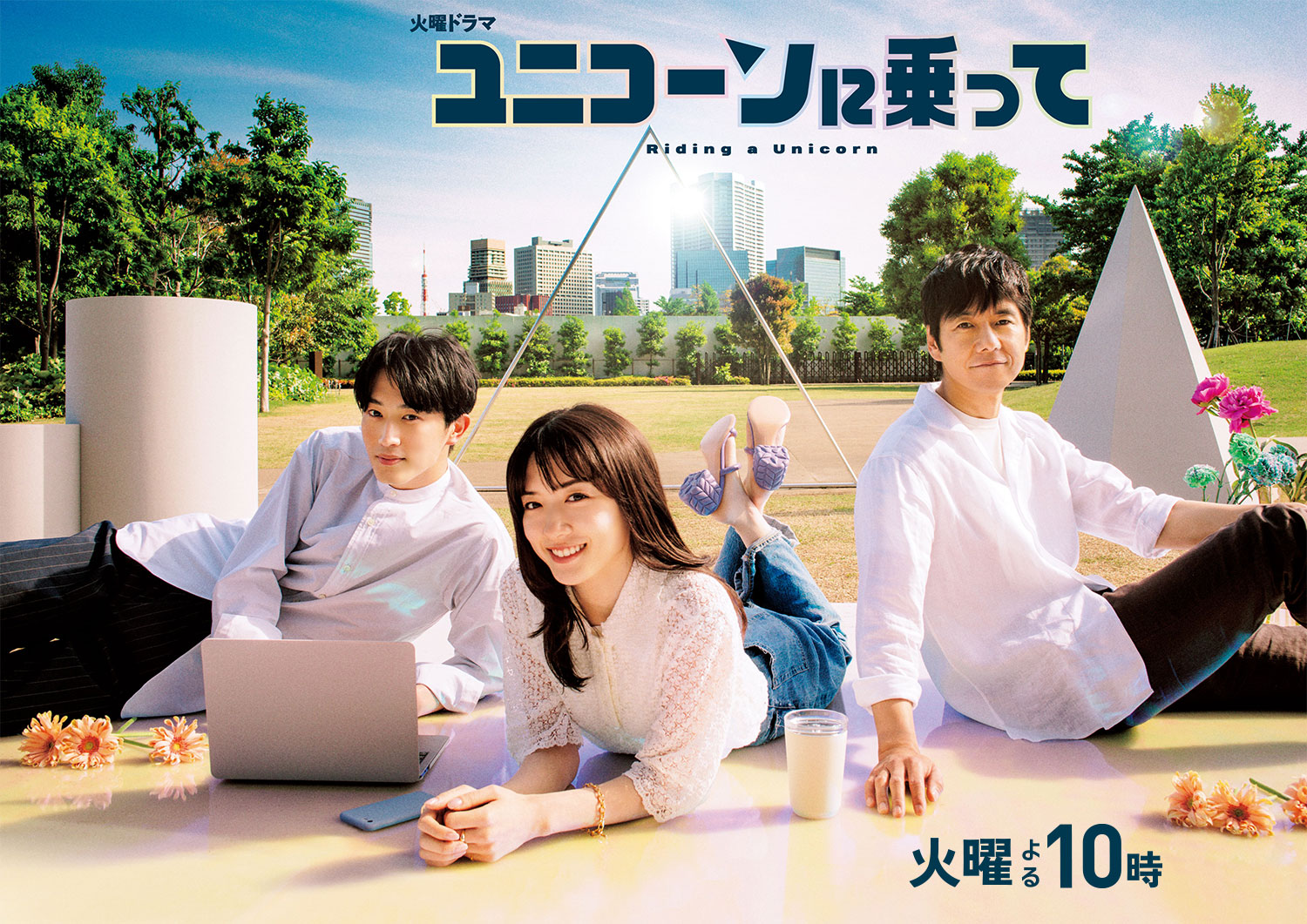
ユニコーンに乗って (Unicorn ni Notte/Riding a Unicorn) - TBS/2022
  • Sana (Nagano Mei from '3-nen A-gumi') was raised by a single mom and couldn't afford college. But after going to a local university to sit in on a seminar by her idol, tech entrepreneur Haneda Sachi (Hirosue Ryouko from 'Naomi to Kanako'), Sana was inspired to become an entrepreneur herself. By sneaking into classes at that same university, Sana met her co-founders: software engineers Kou (her future CTO who fell in love with her but kept it to himself due to their company's "no office dating" rule), and Jirou (her future head engineer).
  • Together, the trio founded Dream Pony, launching an app called Study Pony meant to make education accessible for all people, of all ages, for free. Study Pony was a massive hit when it launched, but now, after three years user numbers are lagging and Dream Pony's main investor is threatening to bail if things don't turn around. Sana comes up with the idea to revamp the app into a virtual campus called Study Pony Campus, and her team hires more staff to make this happen. One new hire is a socially awkward but genius software engineer, and the other is a middle-aged former banker with no tech experience but a passion for education (Kotori, played by Nishijima Hidetoshi from 'Blanket Cats'). While Sana pretends not to be aware of her and Kou's mutual feelings for each other, she also develops a crush on Kotori.
  • Sana's overall goal has been to make Dream Pony a "unicorn" company (a designation for the few start-ups that reach $1 billion in value, also the inspiration for Dream Pony's name and logo). But before that can happen, she must launch Study Pony Campus, get user numbers back up, and secure more investors so the company can stay afloat. Sachi's not convinced that Dream Pony is viable, but later becomes an investor and Sana's business mentor.
Meh: I could never get a solid read on how 'Unicorn ni Notte' wanted me to receive Sachi. At first I thought a Miranda Priestly-esque "never meet your heroes" dynamic was being set up between her and Sana, due to her reasons for rejecting Dream Pony from her "unicorn" incubator program: edtech is unprofitable especially given Japan's declining birthrate, all Sana has is her sob story to market Dream Pony and no actual innovation to back it up, and the dearth of female entrepreneurs in Japan isn't enough reason to give Sana's company a chance. Ouch, right? But then when Dream Pony wins a business competition, Sachi invests in them and even uses her own company's legal team to handle a patent dispute between Dream Pony and another start-up. So she's helping Dream Pony succeed, right? And she's become friends-but-maybe-more with Kotori, the resident nice guy, too. But then, she offers to buy Dream Pony from Sana, since now she apparently sees edtech as lucrative for fostering a new generation of entrepreneurs; Dream Pony would mostly remain as it is, but as a subsidiary of Sachi's company. The show frames this as an opportunity for Dream Pony to go global since Sachi's company is bigger and has more resources, and a chance for Sana and Kou to finally be together since they'll no longer be co-workers. (Kou switches to his father's company once the merger is complete.) And yet. Perhaps I'm simply not business-minded enough to get Sachi's motivations, but I couldn't shake how underhanded her buyout offer felt. Sana barely had time to bask in her own achievement before selling it to someone else.

Speaking of Sana and Kou, I recognize that this show isn't strictly a rom-com and is more about the life cycle of Dream Pony, with each episode exploring a different hurdle or phase that this particular start-up would have to handle in order for its app to succeed. I also understand that in 2022, letting an ambitious female character's career be overshadowed by her love life is played out. However, since the show went through the trouble of tracking Kou and Sana's history while also highlighting her growing attraction to Kotori, I'd hoped the romance would hit harder than it did. Why have a love triangle if it's not going to be juicy? Sana does choose between Kou and Kotori by the end, but the overall romantic element of 'Unicorn ni Notte' is more subdued than I would've liked. In fact, as a whole the show ends in this breezy, open-ended way that wasn't what I was looking for. Nothing is quite as conclusive as I was expecting.
 
Better: My only concern with the Study Pony Campus idea was having people of all ages using the app and learning together. I kept wondering, But... don't the Dream Pony peeps know that the internet is full of pervs? Should adults and children really be enabled to interact without some safety policy in place? So I was relieved to see Sana's team address this issue in episode 7, by devising new features to assuage parental fears about their children being harassed online, and also closing the digital divide in a rural area by having middle schoolers test out the beta version of the app on their school-issued tablets.
 
And in addition to seeing what Nagano Mei can do when not playing a high schooler anymore, I was delighted to see another familiar face: Thelma Aoyama! I've been aware of her for over a decade as one of the more notable Black and Japanese biracial women really doing it big and still having longevity in the Japanese music industry, and I was pleased to see her step into acting as the "Internet Woman" (インターネットの女/Internet no Onna) in 'FM999' last year. So I felt proud seeing her in another, bigger role this time as Megumi, one of Dream Pony's engineers and the only other woman on Sana's core team.

Best: Visually the show is bright and colorful, the design of Dream Pony's HQ looks playful and stimulating, and I appreciate that the show tries to inject some diversity into the office too. For instance, I'd already known that Thelma Aoyama is part Black, but 'Unicorn ni Notte' takes the extra step of showing her character video-calling her parents—with a Black man playing her dad—to remove any confusion about Megumi's racial background. And Kaito, the genius new hire I mentioned earlier, is revealed to be half-Korean; he became such a social recluse due to getting bullied at school for being Korean, and due to being perceived as generally "weird" by his peers and teachers. Of course, these are crumbs as far as depicting diversity goes, but they're crumbs that the show delivers well without being self-congratulatory. 

プリズム (Purizumu/Prism) - NHK/2022
  • Satsuki moved to Tokyo to be a voice actress, and while her roommate's career is off to a solid start, Satsuki realizes it's time to dream a new dream. Both young women work part-time at a plant shop, where Satsuki makes terrariums during slow periods. Satsuki gets let go from the shop, but not before meeting Riku, who's been eyeing her terrariums and whom she runs into while dispatched to a different work location.
  • Satsuki and Riku start dating, he gets her a job at his garden design firm, and he even helps her reconcile with her dad and her dad's male partner Shinji (not necessarily in that order). At first, Satsuki has a strained relationship with both her parents, who divorced when she was in middle school. Her dad had an affair with Shinji, whom he left the family for, and she still feels awkward around both men until Riku brings them all together. Meanwhile, Satsuki's mom nags her about moving back home and settling down, and remains hurt and bitter about the affair... but not forever.
  • What Satsuki doesn't know is that Riku also used to be in a relationship with a man, his former garden design professor (Yuuma) who disappeared seven years ago until now, when Riku's boss hires Yuuma to assist with an important and ongoing project. As Satsuki and Riku's relationship intensifies, Riku seeks answers from Yuuma about why their relationship ended so abruptly and where they stand now, and Satsuki becomes genuine friends with Yuuma before learning that he might also be her rival for Riku's heart.
Meh: Like I said earlier, 'Prism' is slooow. Let's not dwell on it.
 
Better: Ain't no shame in admitting it, I chose 'Prism' because I wanted to see how it would handle queerness. Granted, although Satsuki's dad, Shinji, Riku, and Yuuma are all obviously queer, the show doesn't explicitly attach labels like "queer" or "gay" or "bisexual" to them, and "same sex" only comes up a few times. But I think this lends well to the show's title and how queerness can vary depending on individual queer people's perspectives. (Consider the Merriam-Webster definition of a prism as, "a medium that distorts, slants, or colors whatever is viewed through it.") Which reminds me of the "Woman Who Fell in Love with a Woman" (女に恋した女/Onna ni Koishita Onna) song from 'FM999', where the actress describes sexuality as an ambiguous "gradation" that's never just one thing all the time. 'Prism' is messy in a "feelings and relationships are complicated" sort of way, but not in the cheap "Satsuki and Yuuma fight over Riku while Riku is indecisive about who to choose" way that I selfishly hoped it might be at first. (Although the latter part of that description is true; Riku genuinely wants to be with Satsuki but also can't make his love for Yuuma go away.)
 
I was also impressed by Satsuki and the men closest to her all being designers. She designs terrariums, her dad's an architect, Shinji is a stage designer, Riku is an exec at a garden design firm, and Yuuma is a landscaping expert who taught Riku practically everything he knows.

Additionally, though I didn't choose 'Prism' specifically for Sugisaki Hana (who plays Satsuki), when I began watching I was thrilled to suddenly recognize her as the girl whose mom runs an onsen in Her Love Boils Bathwater. (A 2016 film that I was able to watch earlier this year via Japanese Film Festival Online.) As I mentioned about Nagano Mei, it's refreshing to witness another young actress transition into such a fascinating grown woman role, especially when the only frame of reference I had was of her playing a child.

The ending theme song ("Yabai ne Ai tee Yatsu wa" by Hara Yuuko) kind of gives me "singing from another planet through a can" vibes, but I dig it! And this is just an extra little tidbit that I found out while writing this review: Asano Taeko, the woman who wrote 'Prism', also wrote my beloved 'Koi Nante, Honki de Yatte Dou Suru no?'! How cool is that?
 
Best: What the show lacks in pacing, it makes up for in vulnerability and emotional maturity, especially from episode 5 onward! My goodness! So many conversations, with such carefully written dialogue, addressing such difficult and sensitive subjects, with the characters displaying self-awareness and empathy that I only wish more people possessed in real life. The two instances that stand out to me most are when Satsuki's mom meets Shinji for the first time while visiting her ex-husband in the hospital in episode 5, and the highly charged confrontation that Satsuki, Riku, and Yuuma have in episode 8 when Satsuki insists they all get their intentions out in the open. I don't want to spoil the details of those conversations since they're among the choicest moments of the entire series. But I will say that in both scenes, the woman expresses her pain and frustration without being homophobic, and the men express their sincere desire to cause no further harm without apologizing for loving who they love. Given the circumstances it feels like a fine line to tread, but 'Prism' pulls it off in spades.
 
Alright, so the quartet of summer dramas I watched this time around were pretty aight across the board; loads of intentionality, but nothing altogether earth-shattering. With that said, my favorite of the four is 'One Night Morning' (see part 1 of this review). It's creative, it's short, it's vivid, it's romantic, it's empathetic, it's full of food, and I still can't stop thinking about the purple episode (episode 7) because it's so satisfying. Now that I'm all caught up, I'm curious to see what the fall 2022 J-dramas have in store. Best believe I'll be back to tell y'all all about it!

Thursday, October 20, 2022

ドラマ (Dorama) Time! 29 - pt. 1

No matter that October is almost over! I've just finished watching all four of my J-drama selections from the summer 2022 broadcast season, and I'm here to review them in the order that I finished them! (Which, coincidentally, is the exact opposite from the order that I started them.) The Meh/Better/Best approach that I came up with last time worked really well for me, so I'm going to keep rocking with that. First up are two dramas that I'm categorizing as "short and sexy (?)". They both only have eight episodes, around 25 minutes each, and there's onscreen intercourse that is meant to be sexy, but I was more intrigued by the narratives at play than the backs being cracked (hence the question mark). Plus I'm not usually in the habit of using "sexy" as a descriptor, so there's that too.
 
復讐の未亡人 (Fukushuu no Miboujin/The Vengeful Widow) - TV Tokyo/2022
  • Mitsuki (Matsumoto Wakana from 'Kingyo Tsuma') is the titular widow, whose husband Yuugo was the ace software developer at his job. That is, until he went to work one day and jumped from the roof to his death due to overwork and a hostile office environment.
  • A year later, Mitsuki (going by "Mitsu") has infiltrated her late husband's workplace as an ace software developer just like him, using her friendliness and helpfulness as a facade to investigate Yuugo's demanding boss, the co-workers who offloaded their work onto Yuugo the most, and whoever was the last person to interact with Yuugo before he jumped. She methodically zeroes in on each target and ruins their lives, from poisoning tea to temporarily abducting a cat to playing someone's adulterous sex tape at their wedding reception.
  • Behind the scenes is her brother-in-law Youji, a private investigator who disguises himself at the office and other locations in order to complete whatever task or gather whatever intel Mitsuki needs. Meanwhile, one of Yuugo's former co-workers (now Mitsuki's co-worker) becomes fond of "Mitsu", and adds perspective to who Yuugo was at work.
Meh: What I'm about to say is petty, but this show has the same problem as 'Tokyo Girl' on Amazon Prime. (FYI, I watched that J-drama when it initially debuted on Amazon Prime years ago, but chose not to review it because I wanted it to be just for fun. I might re-watch and review it later though.) And that problem is the hair! In both shows, the main character has a bob in the present, and when she's shown in the past having long hair, it's clearly the same bob with poorly-disguised extensions attached. I'm no hairstylist, so it's not like I could do a better job myself, but come on! At least don't make it so obvious, please!
 
Also, the backstory is that Mitsuki grew up with her future husband and brother-in-law (twins) because they were... her first cousins? Meaning she married (and boinked) her own first cousin? I kept replaying those parts of the show to confirm whether the trio was referring to each other as family in the figurative sense—like how we Black Americans often call non-blood-related loved ones "my cousin"—but I'm fairly certain they were being literal. Which means there's incest in this show that goes completely unaddressed, and it's treated as completely normal that both Yuugo and Youji fell in love with Mitsuki at some point. Apparently she only ever had eyes for Yuugo, even though Youji's the one who acted as her knight in shining armor when she was being abused by her stepdad, and who shared a bond with her that Yuugo knew he wasn't in on. (They committed double-murder as kids and promised to never tell Yuugo about it, but he somehow found out anyway.)
 
Better: Something about the way grief informs Mitsuki's revenge still lingers with me. I was expecting that Mitsuki would want to take the entire company down, but I was wrong. Suing the company would likely be unsuccessful (and the less interesting route), and it actually means something to her to not destroy the entire company, because in her mind that would erase the legacy of her husband's hard work. So the best solution she can come up with is to dole out specific punishments to specific people, using their most precious or most used items against them. Her approach is cunning, but also doomed to leave her dissatisfied because it's not all-encompassing.

On a separate note, I found out after I finished 'Fukushuu no Miboujin' that it's written by the same manga artist (Kurosawa R) who wrote the manga that 'Kingyo Tsuma' is based on. Tonally and from a "women dealing with dark situations but still getting their rocks off" standpoint, this revelation makes perfect sense!
  
Best: Regardless of the results, Mitsuki's commitment to her plan is what sells the entire show. Imagine being so loyal to your loved one and so committed to vengeance that within a year, you: change your name, learn to code, get hired as a programmer on the same research and development team at the same company that worked your husband to suicide, and even have an affair with your dead husband's unrepentant boss so you can slowly poison his tea every time y'all boink? And you convince your private eye brother-in-law to show up as the tea vendor/delivery man/custodian/security guard/whatever invisible role you need him to fill on any particular day? That's a woman who commits, and I respect it! Wouldn't be me, but I respect it!

And all things considered... Mitsuki gets an ending that isn't completely miserable. She executes her plan, has many of her questions answered, gets to walk away from the company without her true identity or motives being exposed, and then as a form of closure she ends the series by sleeping with the one co-worker she'd grown close to during this entire process. She herself is not "happy" per se, but she's done what she set out to do, and she's not all alone at the end.
 
ワンナイト・モーニング (Wan Naito Moningu/One Night Morning) - WOWOW/2022
  • Based on a manga by Okuyama Kenichi, each episode of this anthology series features a pair of young people—mostly 20-somethings, a few teenagers—spending a night together and then deciding how to address their encounter the next day. Despite the show's concept, sex isn't involved in every episode. Sometimes it's simply a pair of characters spending the night together because one of them is too drunk to go home, or one of them has no other place to go for the night, or they're working the night shift together. There's some sort of romantic tension in every episode, but that tension doesn't always lead to sex.
  • Each episode has a central color that informs all the visual elements. Episode 1 is lime green. Episode 2 is yellow. Episode 3 is light pink. Episode 4 is orange. Episode 5 is emerald green. Episode 6 is blue. Episode 7 is purple. Episode 8 is hot pink. Every episode, someone from the featured couple visits the same convenience store, where the lighting and the silent, bored-looking convenience store clerk's uniform always match the central color of that episode. 
  • Each episode also has a central food that the featured couple shares. These foods also tie into the morals of these stories, which I would paraphrase as, "You're more than fine as you are; even if you feel unremarkable, you don't have to become somebody else just to be valuable or useful or lovable. Sometimes you just need someone to see you, and eventually the right people will." Episode 1 is umeboshi onigiri. Episode 2 is shokupan/honey toast. Episode 3 is soumen. Episode 4 is gyuudon. Episode 5 is egg salad sandwiches. Episode 6 is cup ramen. Episode 7 is tsukimi soba. Episode 8 is nikuman.
Meh: The show's title refers to the morning after a one night stand, often referred to by English speakers as "the morning after". Obviously this show was made for Japanese audiences, but if the show creators were going to use an English title anyway, then I'm not sure why they didn't simply call the show 'The Morning After'. Maybe 'One Night Morning' sounds slightly more unique and mysterious? I don't dislike the title as it is, but the phrasing remains curious to me.
 
Better: I was so surprised to see Shigematsu, the silent convenience store clerk, get his own episode and actually talk! Episode 8 (the final episode) is mostly about him and his co-worker bonding over how isolated they feel due to being respectively hyper-visible (her and her large breasts), and invisible (him and his social anxiety). I was even more pleasantly surprised to witness how that finale paints 'One Night Morning' to be an understated thank-you letter to service workers, because after hearing how lonely it makes Shigematsu feel to be ignored by customers, we see a montage showing how the couples from the previous episodes wouldn't have experienced the intimate moments and revelations they had together without Shigematsu selling them the items they needed. He's had a significant impact on at least 14 people, without even realizing it. The last line of the series is literally a new customer telling him "Thank you" after he directs her to the walnut bread that she's come to the store looking for.
 
Best: Absolutely exceptional attention to detail and commitment to color schemes! From lighting to sets to costume design, everything is consistent with the chosen color of each episode. If you're someone who enjoys more of the stylistic aspects of film and TV, then 'One Night Morning' is for you.
 
And there are so many additional moments that I adore from this show! I adore how the male love interest in episode 3 is so smitten with the episode's lead character (his co-worker), that he proposes to her with the assurance that he'll take her last name if she doesn't like the way her new name would sound if she took his. Personally I wouldn't be thrilled to be ambushed with a proposal like that, especially not when I'm eating, and especially since the man and his co-worker have never so much as gone on a date. However! A man who's willing to take my last name? How very special and rare and feminist of you, sir! 
 
I adore all the different shades of blue shown in episode 6 because blue is my favorite color, and I adore that the episode uses Nicholas Britell's "Agape" (or a very convincing sound-alike?) as background music for some of its more emotionally-affecting moments. 
 
I adore how much the bespectacled and seemingly straight-laced lead of episode 7 (a widow who's also another co-worker of the woman from episode 3) is committed to being a discrete horndog. Emphasis on discrete. She has a secret "sex friend" (friend with benefits) of six months that she goes to love hotels with, after which they always eat tsukimi soba together before going their separate ways. Strictly sexual, plus soba. And I adore how vulnerable yet determined her sex friend is when he practically pleads, "I love you, woman! I know you're scared and grieving, but please let me love you!" at the end of that episode, when she tries to deny their mutual feelings for each other. (Also, I know I intimated I was "meh" on the sexiness of both 'Fukushuu no Miboujin' and 'One Night Morning'. But the love hotel scenes in episode 7, coupled with all the purple decor and purple lighting everywhere, truly delivered.)
 
That's all for part 1. Don't miss part 2!

Wednesday, July 13, 2022

ドラマ (Dorama) Time! 28 - pt. 2

Gave you part 1, and now I'm giving you part 2 of this review, as promised! Here are the other two J-dramas, plus an honorable mention, that I watched in spring/early summer this year. I picked the following J-dramas because they seemed like weird and/or scandalous shows that had something thought-provoking to say. (Also, I just found out that they're both based on manga written by a woman named Sakai Eri.) I picked the honorable mention because it's an adaptation of one of my favorite novels.
 
ヒヤマケンタロウの妊娠 (Hiyama Kentarou no Ninshin/Hiyama Kentaro's Pregnancy/Hiyama Kentaro's First Pregnancy/He's Expecting) - Netflix/2022
  • 'Hiyama Kentaro no Ninshin' presents a world where some cisgender men can get pregnant. (No, the show doesn't explain how or why this is happening, only that men who can't or choose not to terminate their pregnancies all give birth via C-section.) Kentaro (Saitoh Takumi from 'Tokyo Dokushin Danshi'), who works at an advertising agency and has casual sex with various women, starts experiencing strange symptoms which include sweating, exhaustion, vomiting, nipple swelling, and lactation. Turns out he's been knocked up by Aki (Ueno Juri from 'Alice no Toge'), his longtime friend with benefits.
  • Aki doesn't want children because it'll likely derail her hard-won career as a writer and photographer; for Japanese women, becoming a mom often means leaving the workforce for good. She heavily supports Kentaro in getting an abortion so they can both move on with their lives. And that's the plan, until Kentaro takes a huge risk by revealing his pregnancy during a pitch meeting at work for an important client. The novelty of him being a pregnant man appeals to the client, and they hire him as one of the spokesmodels for their rebrand campaign. In other words, Kentaro keeps his baby to secure the bag.
  • The downside of this career boost is that without Kentaro's knowledge, his bosses devise a three-year advertising plan to milk him and his baby for all they'll be worth (pun intentional on my part). Meanwhile, Kentaro weathers the challenges of pregnancy and family planning with Aki, while also building community with other men who are or have been pregnant. Surprisingly, this includes Kentaro's own father (played by Lily Franky from 'Kyouen NG' and 'The Naked Director'), a scammer who previously abandoned the family due to the stigma of giving birth to Kentaro back in the 1980s.
Meh: This is less a criticism of the show itself and more a criticism of the fact that even if pregnancy emasculates or feminizes them in the eyes of others, sexism would still work in pregnant men's favor. When Kentaro first starts acting unpredictably and looking disheveled at work, his boss demotes him to administrative duties and busy work that are usually reserved for women. (He basically receives the discriminatory cold shoulder that women often get in the workplace whether pregnant or not, but especially once pregnancy starts affecting their work habits and availability.) The irony of Kentaro deciding to keep the baby is that it has nothing to do with genuine acceptance and support in the workplace, and everything to do with the salaryman's tendency to do whatever it takes to benefit his employer, even if it means exploiting himself. Kentaro's best case scenario, remaining in his bosses' good graces while also securing a modeling campaign, is only available to him because he's a man doing what's seen as a woman's job (being pregnant). If he were a regular degular woman, his employer would view his pregnancy as unremarkable and inconvenient, and he certainly wouldn't be getting a spokesmodel gig or celebrity status from it.
 
Better: However, to the show's credit, 'Hiyama Kentaro no Ninshin' does touch on this double standard. Most of the closest people in Kentaro's life are women, and his female co-workers remind him that, basically, he ain't special! He's only treated as special for doing something that countless women are already expected to do without complaining or questioning or inconveniencing the people around them. Furthermore, there's a lot about carrying and raising children that Kentaro is ignorant of because he's a man who hasn't bothered to know about those things until now.
 
And to Kentaro's credit, him being close with women does contribute to his ability to adapt to pregnancy (once he decides to keep the baby), pay more attention to the discrimination that women face, and be more mindful of his privilege. Sure, people believe he's less of a man because he's carrying a baby—some even insist that he's becoming a "mother," not a father—but he also acknowledges that his newly-acquired media following is due to people being more willing to listen to him than to women. Even though he often states obvious things that women have been discussing online already for ages (like how maternity clothes are too dowdy-looking, etc.).
 
Best: When I first heard about the show and began watching the first episode, I wondered if it might be a commentary on transgender people becoming parents, which would've been fascinating to learn about. But the show goes out of its way to emphasize that this phenomenon is about cisgender male pregnancies (男性妊夫/dansei ninpu, or 男性妊娠/dansei ninshin). With transness unfortunately being left out, the show thoughtfully attempts to explore other gender-related topics, like what male pregnancy would mean for their female sex partners (their baby mamas, if you will). Would it be a lucky opportunity for a woman to have a baby without needing to interrupt her career by carrying it herself, as Aki sees it? Would it be romantic to have a man go through the turmoil of pregnancy, medical appointments, incessant unsolicited advice from others, and the pain of childbirth for her, as Aki's friend sees it? The wife of Kentaro's new preggo friend Miyaji must raise the son they already have (which she gave birth to) in addition to running their florist business and tending to her increasingly hormonal husband. So would having a pregnant husband/boyfriend/FWB actually be triple the burden, like it is for her?
 
I also appreciate how informative 'Hiyama Kentaro no Ninshin' is about Japan's abortion laws. (While 2021's 'FM999' did wow me with its creative approach to the lived experience of abortion, the legal aspect didn't come up at all.) For instance, both Kentaro and Aki must sign a consent form for him to get an abortion as initially planned, which reflects the real-life fact that Japanese women (especially the married ones) often aren't allowed to receive abortions without the other progenitor's (a man's) consent. Relatedly, Kentaro doesn't find out he's pregnant until he's 9 or 10 weeks along, and due to his own circumstances isn't able to schedule an abortion until after the 12-week mark. But by that point an abortion is treated as a stillbirth, and Kentaro would've been required by law not only to bury the fetus, but also report the abortion to a city office so he could receive permission to do the burial...? My googling couldn't tell me how accurate that part is, but imagine the extra hassle and potential trauma of having to do that too!

シジュウカラ (Shijuu kara/Starting at 40/From 40 Onward/After 40) - TV Tokyo/2022
  • Shinobu (Yamaguchi Sayaka from 'Kyouen NG') quits her 20-year middling manga artist career in Tokyo to relocate with her husband and son to a big house in the suburbs. However, one of her comics from over a decade ago (about married women having affairs, something she fantasized about doing early in her marriage when her husband cheated on her) sees a sudden boom in popularity. This prompts the publisher to commission Shinobu to write a brand new series about female infidelity. So she turns one of the rooms of the house into her office, and hires a manga assistant to help her.
  • Said assistant is a baby-faced 22-year-old named Chiaki. While they're drinking at a bar to celebrate completing the first volume of the new series, on what also happens to be Shinobu's 40th birthday (which her husband had forgotten), Chiaki propositions Shinobu but she plays it off. This exchange sets off at least a year of will-they-won't-they, and for most of that time she tries to keep things professional. With her encouragement, Chiaki makes his own comic about being sexually exploited in middle and high school by grown women who paid him for sex. Shinobu doesn't want to be like those women, and even though she briefly runs away with Chiaki, she changes her mind and opts to stay with her family. Shinobu's husband becomes suspicious and starts antagonizing her, but then he almost dies from a heart attack.
  • Five years later, Shinobu and Chiaki have lost contact. Chiaki's manga career has stalled since his debut comic was published, so he works as a chef. Whereas Shinobu's career has flourished, but she's bored and her comics have become uninspired. And her now-retired and dependent househusband is acting increasingly needy. So she has an affair with and tentatively accepts a marriage proposal from a magazine editor, her ex-boyfriend from high school who's commissioned her for a new project. Separately, this same editor also commissions a new project from Chiaki in order to keep tabs on him. Both the editor and Chiaki's live-in girlfriend attempt to drive a permanent wedge between Chiaki and Shinobu when the pair start interacting again, but those attempts ultimately fail.
Meh:  Episode 12 (the final episode) is weird. I know I said weird is what I wanted, but I didn't like it. The editing for that episode is different from the other episodes (I can't describe in technical terms why it's different, but I could just tell). A few supporting characters have random voiceover monologues that no one asked for. Shinobu and Chiaki reunite in a romantic sense, but it still just feels so... unearned? Not just from an age standpoint but a lack-of-chemistry standpoint as well. While it's clear throughout the series why Chiaki is in love with Shinobu, I never understood why Shinobu would still be stuck on Chiaki once she isn't a miserable housewife anymore (once she doesn't need him for escapism anymore). You're 45 now and still longing for this baby-looking young man because why? Because of his prolific talent as a mangaka? Because he saw and empathized with your unhappiness back when no one else did? There's a scene in episode 11 when Chiaki tells Shinobu that he's giving up and wants to forget both manga and her entirely, and she's the one still trying to convince him that her affection for him is genuine even though a relationship between them would never work. I watched that entire scene like, "Shinobu! Girl! Let the boy go live his own life! STANNUP!" Why a woman of her age and success would still be interested in Chiaki is beyond me, and I very much could've gone my whole life without ever seeing the sex scene at the end of episode 12.
 
Better: The scene where Shinobu sits down with Chiaki to help him understand that he was taken advantage of by those grown women of his past is so necessary. As she emphasizes, just because he got money out of it and his body reacted like bodies do when physically aroused, doesn't mean he enjoyed any of it or that entering into those arrangements at such a young age was his own fault. He was a child. He is not a bad person; he's a victim. (And his mom is trifling for knowing what was happening the whole time but never saying anything because she was spending that money too!) 
 
There's a black and white bird with grey wings that appears in Shinobu's earlier work and then reappears (sometimes in Shinobu's imagination, sometimes not) in other parts of the show. For some reason, it took me until after I'd finished the final episode to google the show's title in katakana form (シジュウカラ) and realize that shijuukara is the name of that specific bird! A bird that's also known as a Japanese tit. I was already aware of shijuu as an alternate reading of 四十 or 40 (usually yonjuu), which refers to Shinobu's age and makes the title 'Shijuukara' translate to "From 40 Onward". But I had no idea that 'Shijuukara' was actually a double entendre referencing the bird as well! That's so clever!
 
Best: That ending theme song by SpendyMily, "Koukai"? It GOES! The lead singer's tone and ability to emote with his voice remind me so much of Mitsumura Tatsuya, lead singer of the now-disbanded NICO Touches the Walls (one of my favorite bands in high school and college).
 
Honorable Mention: Pachiko (Season 1) - Apple TV Plus/2022

Based on Min Jin Lee's 2017 novel of the same name, 'Pachinko' is an American production that traces the history of the Baeks, a Korean family contending with Japanese hegemony from 1915 Busan to 1989 Tokyo. (In the show, at least in season 1, the year 1989 is the present.) Much of the events center around the oldest and youngest members of the Baek family. There's Sunja (Youn Yuh-jung from the 2020 film Minari), a permanent resident in Japan who was born in Busan during Japan's colonization of Korea and who moved to Osaka as a pregnant newlywed in 1931. And there's her grandson Solomon, an NYC-based finance guy who takes a temporary assignment in Tokyo in hopes of elevating his career. Solomon was born and raised in Osaka but was sent by his father to continue his schooling in the US as a teenager, and in bubble era Tokyo he mistakenly assumes that his Korean-ness is irrelevant to his professional aspirations because anti-Korean sentiment in Japan is a thing of the past. The deal he's trying to close (convincing a Korean grandmother to sell her home to his firm's client so the client can build a luxury hotel on that land) forces him to confront his Korean identity in unanticipated ways. Concurrently, Sunja reflects on all the difficulty that she's survived and pushes herself to return to her birth country (accompanied by her son Mozasu, Solomon's father) for the first time since 1931. 

Sunja's storyline is extremely faithful to the book, with the exception of her return to Busan (the book version of Sunja never sets foot in Korea again). And although Solomon's character exists in the book as well, the TV version of him is where the 'Pachinko' creators seem to take the most liberties. In the book, there's a character named Noa (Solomon's father's older brother, so his uncle) who similarly struggles to embrace being Korean, to the point of cutting off contact with his family so he can pass as Japanese, and eventually dying by suicide. 'Pachinko' takes the tortured self-hatred of Book Noa and replaces it with the naiveté and arrogance of TV Solomon. TV Noa's misfortune is referenced in retrospect (though not in detail), and he does appear as a child, but it remains to be seen whether season 2 will portray the more tragic aspects of that character as written in the novel.
 
Because Pachinko is one my favorite novels, watching the TV adaptation has been a no-brainer for me ever since I first heard that it was in development. And then I heard that Youn Yuh-jung was playing Sunja, that Hallyu superstar Lee Min-ho (my K-drama crush in high school) was playing Sunja's yakuza baby daddy Hansu, and that Justin Chon (Seoul Searching, Gook, etc.) was one of the co-directors, and that's all I needed to know! Masterful wouldn't even scratch the surface of describing what a cinematic and historical gift 'Pachinko' is. You wanna talk about art that sets the proverbial captives free? This show is it! Especially episode 4, where Sunja and Solomon each witness different forms of Korean resistance and embrace getting rained on (literally) as they return to their true selves. And Lee Min-ho's solo episode (episode 7) about how Hansu survived the 1923 Great Kanto Earthquake AND the ensuing Kanto Massacre that targeted Korean people? That was a big-budget history lesson that broke my heart. Those events aren't mentioned in the novel, so I know the 'Pachinko' team did their research for that one! Have I not said enough? Watch 'Pachinko' if you know what's good for you!

Having reviewed all the Japanese and Japanese-ish dramas that I've watched recently, I gotta pick a favorite, right? Excluding the honorable mentions, 'Kikazaru Koi ni wa Riyuu ga Atte' is my favorite this time around. Sure, 'Koi Nante, Honki de Yatte Dou Suru no?'' has a very similar premise and a similarly lengthy title, commits more to its romantic angle, and has a more cohesive plot (especially if we're comparing final episodes). But 'Kikazaru Koi' has Yokohama Ryuusei as the male lead, stealing every scene he's in even when he has no dialogue, and for that, 'Kikazaru Koi' is the winner in my book! And if we're including the honorable mentions, then 'Pachinko' far and away surpasses all of the other five shows. Yes, I'm biased because it's based on a book I already love, but so be it! Now off I go to watch more J-dramas!